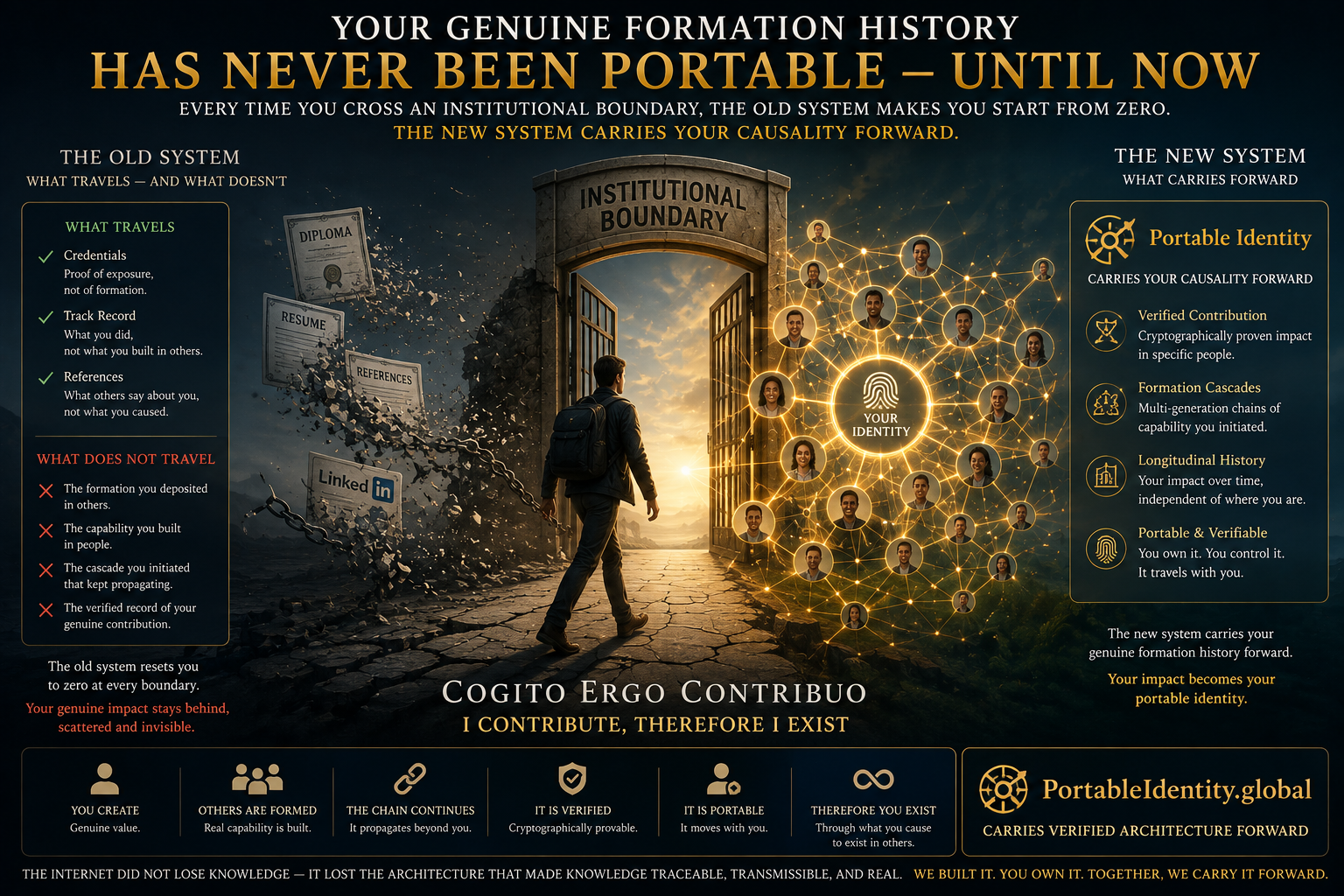
Every time you change employers, cross an institutional boundary, or enter a new professional context, the same thing happens.
You start over.
Not from thirty percent. Not from a fraction of what you built. From zero.
The credentials travel. The skills travel. The platform-visible signals — the resume, the references, the professional profile — travel.
What does not travel is the evidence of what you genuinely caused in others. The formation you deposited in colleagues. The capability you built in the people you mentored. The causal chain you initiated that continued propagating without you.
This loss is not a failure of memory. It is a structural property of how professional identity currently works. And it has a name.
Two Problems. One Architecture.
AI development faces a ceiling.
AI has scaled everything except the only dimension that determines intelligence: who it can actually learn from. Every investment in compute, every architectural innovation, every scaling law — all of it approaches the ceiling determined by the completeness of the training data. And the training data is bounded by what was made visible on platforms designed to monetize attention. The invisible majority of human expertise — private collaboration, tacit knowledge, genuine mentorship, longitudinal formation — does not exist in the training signal.
You cannot exceed the ceiling of your training data, and the internet’s ceiling was set by incentives that had nothing to do with truth.
This is The 30% Ceiling: AI’s structural limitation in reaching genuine human expertise.
Human professionals face a different structural problem. Not a ceiling — a reset.
Where AI is limited to the visible fraction of what humans know, human professionals are limited to zero at every institutional boundary. The formation they produced in others — the capability they genuinely deposited, the cascade they genuinely initiated — does not cross the boundary with them. It stays behind, scattered across the careers of the specific people who received it, connected to no persistent record, inaccessible to any subsequent institution.
The invisible 70% is not hidden — it is structurally unrepresentable without identity architecture that can carry causality forward.
These are not the same problem. AI’s ceiling is a visibility problem. The human reset is an identity architecture problem. But they share a root cause: the absence of infrastructure that makes genuine human contribution traceable, portable, and verifiable across boundaries.
The internet did not lose knowledge — it lost the architecture that made knowledge traceable, transmissible, and real.
What Happens at Every Reset
Examine concretely what is preserved and what is lost when a professional crosses an institutional boundary.
What travels:
Credentials — the certified record that a program was completed, criteria were satisfied, institutional recognition was granted. Credentials indicate that the holder was exposed to a formation process. They do not verify that genuine formation occurred.
Platform-visible track record — the public record of what outputs were produced, what roles were held, what metrics were achieved. Track records indicate observable performance during the period of record. They do not verify whether that performance reflected genuine formation or temporary performance enabled by the institutional infrastructure that no longer accompanies the professional to the next context.
References — attestations from people willing to assert positive things about the professional at the moment of transition. References indicate that specific people are willing to make specific claims. They do not verify whether those claims reflect genuine formation or optimized professional relationship management.
What does not travel:
The verified record of who became genuinely more capable through genuine encounter with this professional’s genuine formation — the irreversible cognitive architecture built through genuine encounter with genuine difficulty. The cascade that genuine formation transmission produces — specific people who were formed, who independently formed further people, across generations that the original professional never directly reached. The longitudinal history of what genuine formation produced in the world, in specific verifiable others, across time, independently of the professional’s continued presence.
This is not a minor omission. It is the omission of the most significant and most verifiable record of genuine professional contribution that exists.
The old system forces every human being to start from zero at every institutional boundary. The new system carries your causality forward.
The Compounding Asymmetry
The institutional reset does not affect all professionals equally. It creates a systematic asymmetry that becomes more severe over time.
The professional who has invested genuinely in genuine formation — who has spent years depositing genuine capability in others, initiating cascades of genuine capability development, building formation that persists and propagates independently — accumulates a history of genuine contribution that compounds over time.
Their formation does not degrade. It multiplies. The people they genuinely formed become capable of forming further people. The cascade continues propagating, branching, compounding, across contexts the original professional never directly touched.
This history is the most complete and most verifiable record of genuine professional value that exists. It is also the history that the institutional reset destroys most completely — because it exists entirely outside any platform-visible record, scattered across the careers of the specific people in the cascade, connected to no persistent identity, recoverable by no institutional instrument currently in use.
The professional who has invested in platform-visible signals — credentials, quantifiable metrics, engagement-optimized profiles — accumulates a history of visibility. This history is easily portable. It crosses institutional boundaries in standard documents. It requires no special infrastructure to present.
But visibility degrades. Credentials require renewal. Platform profiles require continuous maintenance. The professional who has spent thirty years optimizing for visibility finds that thirty-year-old visibility signals have limited value — because visibility is not cumulative, it is contemporaneous.
Formation compounds. Visibility degrades.
The institutional reset systematically disadvantages the professionals whose contribution is most cumulative and most permanent — and systematically advantages the professionals whose contribution is most visible and most temporary.
This is not a marginal distortion. It is the foundational misalignment of professional evaluation: the instruments designed to identify genuine professional value systematically fail to reach it, and the proxies they use instead systematically reward a different property.
The Architecture That Makes Causality Unportable
Why does genuine formation not travel across institutional boundaries?
Not because it is secret. Not because institutions do not want access to it. Because the current architecture of professional identity provides no mechanism for connecting genuine formation to a persistent, portable identity that crosses boundaries with the professional.
Professional identity currently exists in fragments:
The credential exists on the issuing institution’s records. The platform-visible contribution exists on the platform’s servers — accessible only while the platform exists and only in the form the platform’s data model supports. The references exist in the goodwill of specific individuals at specific moments. The genuine formation deposited in others exists in the capabilities of the specific people who received it — scattered across their subsequent careers, connected to no persistent record of who caused those capabilities to exist.
None of these fragments connect to each other. None travel together. None persist across the full span of a professional career in a form that any subsequent institution can access.
The result: at every institutional boundary, a new institution encounters a professional who is, from the institution’s perspective, essentially a stranger. They can see the credentials. They can see the platform-visible signals. They cannot see the genuine contribution — because no architecture currently connects genuine contribution to portable identity.
This is not a failure of institutional sophistication. It is an architectural constraint: you cannot access what no infrastructure is designed to make accessible.
Portable Identity is not an upgrade to AI; it is the missing precondition for intelligence that can compound rather than imitate.
The same statement applies to human professional evaluation: Portable Identity is not an upgrade to credential systems; it is the missing precondition for professional recognition that can reach genuine contribution rather than its platform-visible proxies.
Who the Reset Harms Most
The institutional reset does not affect all professionals equally. Its harms concentrate precisely in the categories of professionals whose contribution is most genuine and most permanent.
The Deep Expert
The practitioner whose genuine expertise was built through genuine irreversible encounter with genuine difficulty over years or decades. Their expertise is deep and generative — capable of reconstruction in novel contexts, capable of transmission to others in ways that persist independently. It is also largely invisible on platforms designed to reward accessible, sharable, engagement-optimized content.
At every institutional boundary, the deep expert presents credentials that were designed for a different kind of expertise and platform signals that were optimized for visibility rather than depth. The genuine formation that distinguishes them from credential-equivalent but formation-shallow peers is inaccessible to every evaluation instrument in standard use.
The Mentor
The professional whose most significant contribution is the formation of others. Who built practitioners who built practitioners — across generations of genuine capability development that traces back through a chain of genuine formation encounters to their foundational contribution.
This contribution is entirely absent from standard professional evaluation. It does not produce metrics, output counts, or platform-visible signals in the mentor’s record. It produces capability in other people’s careers. At every institutional boundary, the mentor’s most significant contribution is structurally invisible.
The Practitioner Who Crossed Contexts
The professional whose genuine formation built genuine capability that transfers across domains — whose cascade history spans institutional contexts that standard evaluation treats as disconnected. The formation deposited in one context that produced practitioners who applied it in entirely different contexts is invisible in the record that travels with the professional, because no architecture currently connects the cross-contextual cascade to a persistent portable identity.
The Professional Who Does the Work
The person who invests their professional energy in genuine formation rather than visibility optimization. Who deposits genuine capability in others rather than producing impressive signals about depositing capability. Whose contribution is most real and least visible, because the incentive structures of platform visibility reward the performance of contribution rather than its substance.
These are not fringe cases. They are the professionals on whose genuine formation genuine professional ecosystems depend — the people who actually transmit the expertise that makes fields capable of genuine advancement.
They are also the people most systematically disadvantaged by professional evaluation systems that can only reach the 30% that was made platform-visible.
What Carrying Causality Forward Means
Cogito Ergo Contribuo — I contribute, therefore I exist — is the proof of conscious existence through verified contribution. It is also the proof that does not reset.
When this proof is established and carried through Portable Identity, the institutional reset ceases to be structurally inevitable. For the first time, a professional can arrive at every institutional boundary carrying something that no boundary previously permitted them to carry: verified evidence of what they genuinely caused in others.
Not a credential that certifies institutional exposure. Not a track record that documents platform-visible performance. Not a reference that attests to someone’s willingness to make positive assertions. Verified causal evidence — the specific structural pattern that genuine conscious contribution necessarily produces and that the institutional reset has, until now, left behind at every boundary.
The elements of this proof are specific:
Temporal Persistence. Evidence that genuine formation persisted in the contributor — tested independently, after sufficient time, with all assistance removed. What the contributor genuinely carries, not what they temporarily acquired or borrowed from the institutional infrastructure that supported their performance.
Causal Transmission. The verified record of specific people whose capability genuinely changed through genuine encounter with the contributor’s genuine formation — who demonstrate that capability independently, who independently enabled further people. Not claimed impact. Verified pattern.
Cascade Topology. The complete map of what genuine formation produced across every node in the network — every person reached directly or through propagation, across the full generational span of the cascade. The longitudinal record of what genuine contribution produced in the world, connected to a persistent portable identity.
Portable Carrying. The complete verified record — carried across every institutional boundary, controlled by the professional it belongs to, accessible in every context where professional existence needs to be established.
This is the architecture that makes causality portable. Not a better credential. Not a more complete platform profile. An infrastructure that makes genuine formation traceable, transmissible, and verifiable — for the first time.
The Paradigm Shift
Professional evaluation has always asked: what do you claim to have done?
The proxy systems that evolved to answer this question — credentials, references, track records, platform-visible signals — were approximations, designed for a world where genuine formation was unverifiable and behavioral observation was the only instrument available.
That world established the institutional reset as a structural feature: because genuine contribution could not be verified, it could not be carried. At every boundary, only what could be documented in standard formats crossed with the professional. Everything else reset to zero.
The Fabrication Threshold ended the reliability of even this approximation. When behavioral signals of genuine professional contribution became replicable without genuine professional contribution, the proxies that sustained the visible fraction of professional evaluation collapsed — producing the same structural condition that The 30% Ceiling describes for AI: an evaluation system that measures the visible fraction while being structurally blind to what matters most.
The question that professional evaluation can now ask — for the first time — is: what does the world show you actually built?
Not what credentials certify was completed. Not what platforms recorded was produced. Not what references assert was achieved. What the world shows — in the specific capability of specific verifiable people who genuinely received genuine formation, who demonstrate that capability independently, who themselves built capability in further people.
The paradigm shift is from Claim to Persistence.
Not what you claimed — but what persisted. Not what the platform recorded — but what the world shows. Not what the resume summarizes — but what the cascade proves.
The institutional reset was not inevitable. It was architectural. And architecture can change.
The Proof That Does Not Reset
For the first time, a professional can carry a verified existence proof across every institutional boundary that previously required them to start over.
Not credentials — though credentials remain.
Not a platform profile — though platform visibility remains.
Not references — though references remain.
A verified causal record of what genuine formation produced in specific verifiable others — portable, controlled by the professional, accessible everywhere, owned by no institution.
The professional who carries this record does not start over. They arrive.
They arrive with the verified history of what they genuinely built — in specific people, across time, across generations they never directly reached. The institutional boundary that previously severed this history from their identity no longer severs it — because the architecture that connects genuine contribution to portable identity now exists.
The old system forced every professional to start from zero at every institutional boundary.
The new system carries your causality forward.
Not as a claim. As verified pattern in the world — in specific people, across time, established through independent instruments, portable across every context where professional existence needs to be established.
Cogito Ergo Contribuo.
I contribute, therefore I exist.
And what I genuinely built in others — for the first time — travels with me.
→ CogitoErgoContribuo.org — The proof of conscious existence through verified contribution → PortableIdentity.global — The infrastructure that carries the proof across institutional boundaries → CascadeProof.org — Verifying that genuine formation genuinely transmitted → PersistoErgoDidici.org — What persists was genuinely built → GenuineFormation.org — What genuine formation requires at the source → The 30% Ceiling — AI’s structural limitation in reaching genuine human expertise → The First Integration Advantage — The organizational mirror of this individual proof → Seven Standards. One Proof.