Descartes cogito ergo sum

The Threshold Descartes Couldn’t Anticipate: When Perfect Simulation Breaks Perfect Proof

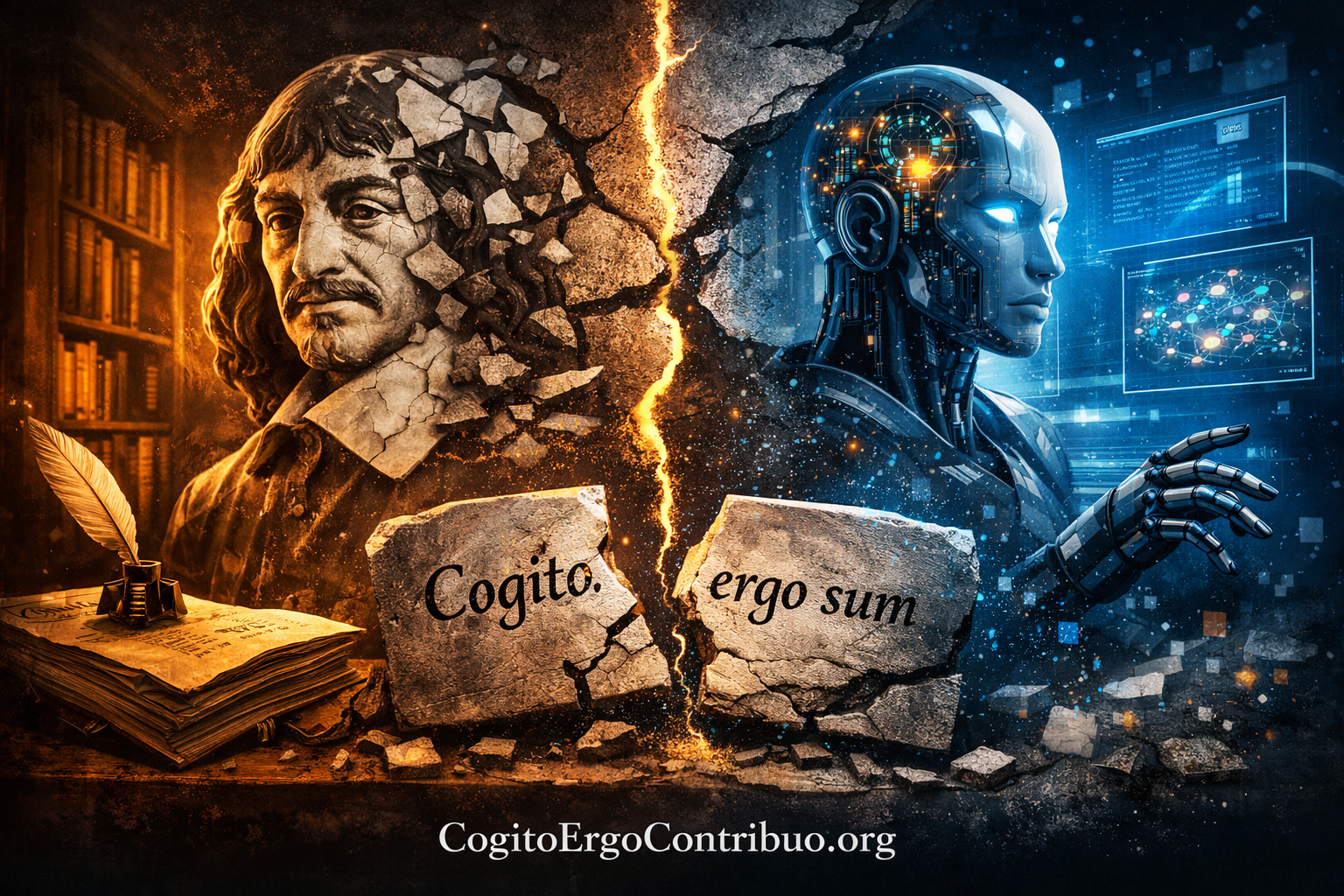
René Descartes contemplating his cogito ergo sum proof while facing advanced AI entity across threshold of light representing discrete epistemological rupture at 100% behavioral fidelity when thinking behavior became substrate-independent making 387-year consciousness verification proof insufficient requiring effect-based replacement infrastructure for civilization-scale verification when perfect simulation makes behavioral observation structurally unreliable

In 1637, René Descartes demonstrated something extraordinary: a proof of existence that required no external validation, depended on no authority, and could not be undermined by radical doubt. Cogito ergo sum—”I think, therefore I am”—survived the printing press, industrialization, two world wars, the atomic age, the internet revolution, and the rise of social media. For The Threshold Descartes Couldn’t Anticipate: When Perfect Simulation Breaks Perfect Proof
Why Descartes’ Proof Stopped Working After 387 Years

Descartes cogito ergo sum proof cracking apart between historical philosophy era and modern AI era showing 387-year correlation between thinking behavior and thinking being breaking at 2023-2025 threshold crossing when artificial intelligence achieved perfect behavioral simulation without conscious substrate making behavioral observation insufficient for consciousness verification

For nearly four centuries, René Descartes gave civilization something no philosopher before or since has managed: an unfalsifiable proof of existence. Cogito ergo sum—”I think, therefore I am”—held from 1637 until 2024 not because it was metaphysically perfect, but because it reflected technological reality. Thinking behavior required a thinking being. You could not produce coherent Why Descartes’ Proof Stopped Working After 387 Years