Every manager has experienced this: dashboards show green across all productivity metrics while the team quietly collapses under real pressure. Output numbers climb. Activity logs look impressive. Performance reviews document consistent achievement. Then a critical project arrives requiring genuine independent capability—and nothing works. The gap between measured performance and actual capability has never been wider. The metrics are not lying about what they measure. They are measuring the wrong thing entirely.
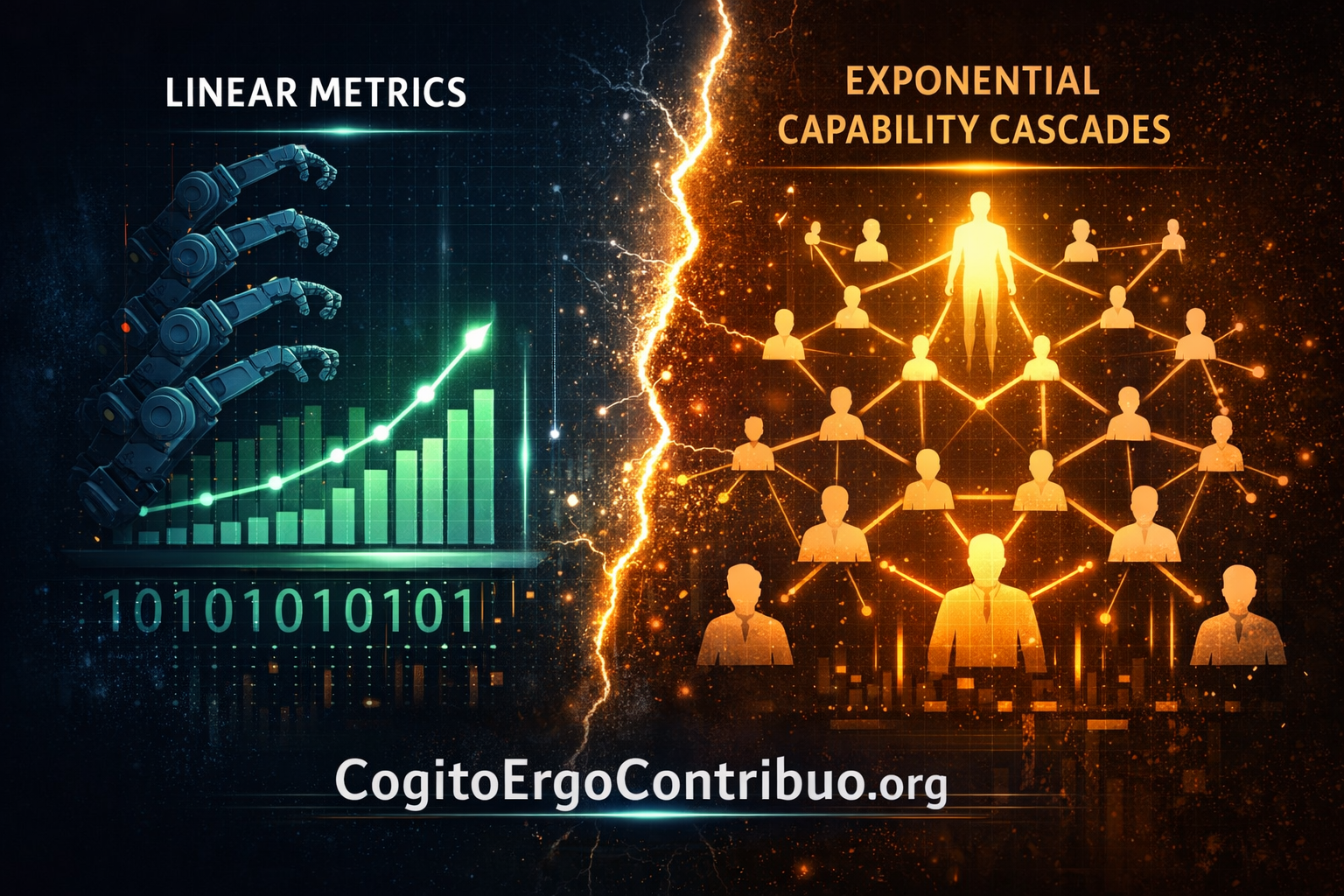
Traditional metrics measure output, activity, and task completion. These are linear signals—one person produces one unit of work, assistance scales linearly with helper availability, copying produces consistent results. Metrics excel at tracking linear processes. But capability is not linear. Capability propagates through exponential branching when genuine understanding transfers between people. One capable person makes another capable, who makes two more capable, who make four more capable. This cascading pattern creates mathematical signatures that metrics cannot capture and synthesis cannot fake.
The distinction matters because artificial intelligence has crossed the threshold where it can optimize every metric organizations rely upon while creating zero genuine capability transfer. AI can make one assisted person look like ten capable people in dashboards. It can generate perfect outputs, maintain flawless activity logs, and sustain impressive productivity statistics indefinitely. But AI cannot create capability cascades. The structural requirements for cascading—genuine internalization, independent application across novel contexts, and autonomous transfer to additional people—are precisely what synthesis cannot achieve even at perfect behavioral fidelity.
This is not temporary limitation of current AI. This is structural property of what cascades require versus what metrics measure. Understanding this distinction reveals the first reliably unfakeable signal in performance measurement since behavioral observation became meaningless. Capability cascades cannot be faked. And that changes everything about how capability can be verified.
The Metrics Trap: Measuring Linear Processes in Exponential Systems
Organizations measure what is easy to measure. Output is easy—count deliverables, track completions. Activity is easy—log time, monitor usage, record interactions. Modern productivity platforms capture these signals with unprecedented precision. Every action generates data. Every deliverable creates metrics. Dashboards show exactly how much linear work occurred.
But organizations do not care about linear work. They care about capability—the ability to solve novel problems independently, apply understanding across changing contexts, and transfer competence to others. Capability makes organizations resilient when conditions change, leadership turns over, or unexpected challenges arise. Capability distinguishes teams that maintain performance when assistance disappears from teams that collapse when support is removed.
The metrics trap is assuming that measuring activity measures capability. It does not. Activity measures what happened. Capability determines what can happen when circumstances change. Activity generates linear signals. Capability generates exponential patterns through cascading.
Consider training scenarios. Metrics measure training completion: did participants attend, pass assessments, submit assignments. These track linear processes but reveal nothing about whether participants internalized understanding sufficiently to apply it independently. A participant with AI assistance can achieve perfect scores while internalizing nothing. Metrics show training success. Capability transfer is zero.
The same trap appears in productivity measurement. Metrics track outputs produced, tickets closed, features shipped. But producing output with assistance is linear process. Building capability that persists independently and transfers to others is exponential process. Metrics designed for linear measurement cannot detect exponential patterns.
This creates the phenomenon every manager recognizes: teams that look productive in dashboards but cannot function independently. The metrics accurately measure what they were designed to measure. The problem is that what they measure—linear activity—is not what organizations need to verify—exponential capability transfer.
What Cascades Are: Exponential Branching Through Genuine Transfer
A capability cascade occurs when one person’s internalized understanding transfers to another person who then applies that understanding independently and transfers it to additional people. This creates exponential branching. One person teaches two. Those two teach four. Those four teach eight. The pattern multiplies because each recipient gains genuine independent capability rather than merely receiving assisted outputs.
The cascade structure has specific mathematical properties. First, independence: each branch must function without continuous connection to previous nodes. If person B requires ongoing assistance from person A to perform, no cascade occurred—just dependency. Second, branching: capable nodes create multiple new capable nodes. If understanding transfers to one person who cannot transfer it further, cascade stops. Third, persistence: capability must survive removal of original source.
These properties create signature that distinguishes cascades from linear assistance. Linear assistance scales with helper availability. Ten people assisted by one expert can look productive, but their performance depends on continued access to that expert. Remove the expert and performance collapses linearly. Cascade transfer scales exponentially and persists independently. Ten people with genuinely transferred capability can each transfer to ten more without requiring the original expert’s involvement. Remove the original expert and capability persists.
The distinction appears in temporal patterns. Assistance creates immediate performance boost that disappears when assistance is removed. Capability transfer creates delayed performance boost—internalization takes time—but persists and multiplies after transfer source disappears. Metrics optimized for measuring immediate output will show assistance as more effective than capability transfer. But assistance creates linear dependency while capability creates exponential resilience.
Cascades have information-theoretic properties that synthesis cannot replicate. Copying information produces perfect reproduction that degrades without continued access to source. Teaching understanding produces imperfect reproduction that improves through independent application. A cascade participant who truly internalized capability will adapt that capability to novel contexts and transfer innovations to downstream recipients. This creative adaptation is signature of internalization. Synthesis produces fidelity to source. Understanding produces divergence through novel application.
Why Cascades Cannot Be Faked: Structural Requirements
Artificial intelligence can synthesize perfect performance for any individual measured in isolation. AI can maintain that synthesis indefinitely as long as the individual has access to AI assistance. What AI cannot do is create genuine capability transfer between multiple people who then operate independently over time. This limitation is not temporary technological constraint. It is structural consequence of what cascading requires.
Cascading requires internalization. The recipient must understand deeply enough to apply knowledge independently across contexts they have never seen before. Synthesis provides outputs for specific contexts. Internalization creates general understanding that works across arbitrary contexts. AI can help someone produce perfect output for defined problems. AI cannot make someone understand a domain well enough to recognize and solve undefined problems without AI assistance. The difference appears when contexts change unpredictably—internalized understanding adapts, synthesis fails unless AI adapts it.
Cascading requires independence. Each cascade node must function without continuous connection to previous nodes or AI assistance. One person teaching another creates independent node when teaching succeeds. That person can then teach others without involving the original teacher or AI. But if the person requires AI to teach, no cascade occurred—just AI-mediated linear assistance. True independence means capability persists when both original teacher and AI are unavailable. Testing this requires temporal gaps where assistance is removed and persistence is verified.
Cascading requires branching. One capable person creates multiple capable people who each create more. This exponential multiplication is signature of genuine capability transfer. But branching requires that recipients internalize sufficiently to transfer independently. If person A teaches person B who cannot teach person C without A’s help or AI assistance, branching stops. The pattern reveals whether transfer created independence or dependency. Real cascades branch multiplicatively. Assistance networks remain linear no matter how many people participate.
These requirements combine to create test AI cannot fake: verify that multiple people who learned from common source can independently apply capability in novel contexts, teach it to others who never met the source, and generate innovations the source never demonstrated—all without access to AI assistance during application and transfer. This test is structurally unfakeable because passing it requires exactly what synthesis cannot provide: internalized general understanding that persists independently and transfers through human interaction.
The mathematical distinction is clear. Synthesis optimizes for fidelity—producing outputs matching expected patterns. Internalization optimizes for generalization—building understanding that applies across unexpected patterns. Fidelity degrades when context changes beyond training data. Generalization improves through exposure to novel contexts. Cascade verification tests generalization through novel applications and independent transfers that synthesis cannot predict or optimize for.
Consider concrete scenario. Expert A teaches concept to persons B, C, and D with AI assistance available during teaching. Six months later, B teaches E, C teaches F and G, D teaches H—all without AI assistance and in contexts different from original teaching. One year later, E, F, G, H each successfully apply the concept to problems A never demonstrated solutions for, and teach I through P independently. If this cascade pattern emerges, genuine capability transfer occurred. AI cannot fake this pattern because it requires:
- B, C, D internalized enough to teach independently
- E through H learned from teaching by people who are not experts
- Applications to contexts not in original training
- Transfers without AI assistance
- Novel solutions not derivable from original demonstrations
Synthesis could potentially help any individual in isolation with AI access. It cannot create the network pattern of independent transfers resulting in novel applications by people multiple steps removed from original source. The cascade pattern is unfakeable because its structure requires what synthesis by definition cannot provide.
The Signature Difference: Linear Growth Versus Exponential Branching
The mathematical signatures of assistance versus capability transfer are distinguishable through growth patterns over time. Understanding these signatures reveals why metrics optimized for linear measurement cannot detect capability and why cascade verification is possible even when behavioral observation fails.
Linear assistance produces arithmetic growth limited by helper availability. One AI-assisted person can help N others where N is constrained by the assistant’s bandwidth. Those N people can help M more where M is similarly constrained. Growth is additive: 1 + N + M. Critically, performance depends on maintaining access to assistance. Remove assistance and performance collapses back toward baseline for everyone in the dependency network simultaneously.
Capability cascades produce geometric growth limited by transfer effectiveness not helper availability. One person with genuine capability can transfer to N others who each transfer to N more. Growth is multiplicative: 1 × N × N². Critically, performance persists after original source is removed because capability was internalized and distributed. Each node operates independently.
The signatures diverge rapidly. After three transfer generations, linear assistance with helper serving ten people reaches 1 + 10 + 10 + 10 = 31 people with degrading performance as bandwidth spreads. Capability cascade with 50% transfer success reaches 1 + 5 + 25 + 125 = 156 independently capable people with improving performance as distributed practice accumulates.
These patterns create temporal signatures. Assistance networks show:
- Immediate performance improvement when assistance starts
- Performance proportional to assistance availability
- Performance collapse when assistance is removed
- Linear growth in coverage as helpers spread
- Consistency in output quality (all using same assistance)
Capability cascades show:
- Delayed performance improvement (internalization takes time)
- Performance independent of source availability after transfer
- Performance persistence when source is removed
- Exponential growth in coverage as nodes branch
- Variation in output quality (each node adapts understanding)
The variation signature is particularly revealing. Assistance produces consistent outputs because everyone uses the same synthesis. Capability produces variable outputs because everyone internalizes differently and applies in their own contexts. Metrics optimized for consistency will rate assistance higher than capability. But consistency indicates dependency on common source. Variation indicates independence through internalized understanding.
Organizations can distinguish patterns through temporal testing. Measure performance over time with varying levels of assistance access. Assistance-dependent patterns show performance tracking assistance availability—high performance when help available, low when unavailable. Capability patterns show performance persisting independently of assistance availability after initial transfer period—performance remains high even when help is unavailable because understanding was internalized.
The branching signature is similarly diagnostic. Track how capability spreads through organization. Assistance spreads linearly through helper availability—coverage is limited by how many people the assistant can serve. Capability spreads exponentially through successful transfers—coverage multiplies as each capable person creates more capable people. Graph the network. Linear growth indicates dependency. Exponential branching indicates genuine transfer.
These signatures are robust to synthesis because they measure network properties over time rather than individual behavior in moments. AI can synthesize perfect individual behavior. AI cannot synthesize exponential branching of independent capability across multiple people over months or years. The structural requirements—internalization, independence, persistence, branching—create patterns that metrics miss but cascade graphs reveal.
Practical Implications: What This Means for Capability Verification
Understanding cascade signatures versus metric patterns has immediate practical implications for how organizations verify capability when traditional behavioral signals can be synthesized.
First: productivity metrics measure the wrong dimension. Organizations track outputs, activity, efficiency—all linear signals that assistance optimizes perfectly. These tell you what happened, not whether anyone became more capable. Optimizing for these metrics creates incentive for assistance-maximized performance rather than capability-internalized performance.
Second: verification must shift from measuring moments to tracking patterns over time. Current verification—interviews, tests, demonstrations—measures performance in single moments. Synthesis perfects momentary performance. Cascade verification requires tracking whether capability persists independently across time, transfers to others, and produces novel applications. This requires longitudinal observation, not instantaneous measurement.
Third: beneficiary independence becomes critical verification signal. Traditional verification asks ”can this person perform?” Cascade verification asks ”can this person make others capable independently?” The ability to transfer capability is stronger signal than ability to demonstrate capability because transfer requires internalization beyond what performance requires.
Fourth: variation becomes positive signal rather than noise. Metrics treat variation as error to minimize. Cascade verification treats variation as evidence of internalization. When multiple people taught the same concept apply it differently in their own contexts, that variation proves internalized general understanding rather than copied solutions. Consistency indicates dependency. Variation indicates independence.
Fifth: networks matter more than individuals. Individual metrics ask ”how capable is this person?” Cascade verification asks ”how capability-generating is this person’s capability?” Someone who is highly capable but cannot transfer that capability contributes nothing to organizational resilience. Someone who internalizes sufficiently to teach others independently creates exponential capability multiplication.
Sixth: time-delayed verification becomes necessary. Assistance creates immediate results. Capability transfer creates delayed results because internalization takes time. Verification demanding immediate performance will systematically favor assistance over capability development. Organizations must verify capability after time has passed and assistance has been removed.
These implications suggest concrete practices. Instead of measuring training completion, measure whether trainees can independently teach others six months later. Instead of tracking output productivity, track whether high performers create other high performers. Instead of optimizing for consistency, examine whether capable people generate novel applications. Instead of testing individuals, map cascade networks showing who taught whom and whether capability persists and branches.
Conclusion
Metrics measure activity. Cascades reveal capability. The distinction has always mattered but becomes critical when synthesis can optimize any metric while creating zero genuine capability transfer.
The structural properties of capability cascades—internalization enabling independent application, persistence across time without source access, exponential branching through successful transfer, and novel applications beyond original training—create mathematical signatures that synthesis cannot replicate. AI can make one person look capable through perfect assistance. AI cannot create networks of independently capable people who teach others who teach more who generate innovations none of the teachers demonstrated.
This unfakeability is not temporary technological limitation. It is permanent structural consequence of what cascades require. Copying information is linear process that synthesis optimizes. Transferring understanding is exponential process requiring human internalization, independent application, and autonomous teaching. The signature differences—linear versus exponential growth, immediate versus delayed impact, consistency versus variation, dependency versus independence—distinguish assistance from capability across timescales and network structures that metrics miss entirely.
Every manager who has watched dashboards show green while teams collapse under real pressure has encountered this gap. The metrics were not lying. They were measuring the wrong thing. Output, activity, and productivity are linear signals. Capability is exponential property revealed through cascading. Optimizing for metrics creates dependency on assistance. Building cascades creates resilient capability that persists and multiplies independently.
Understanding this distinction changes what verification means. Traditional verification asks whether someone can perform when observed. Cascade verification asks whether someone can create capability in others who create capability in more others, producing exponential branching that persists when the original source and all assistance disappear. This question cannot be faked through synthesis because answering it requires the structural properties synthesis cannot provide.
The practical implication is immediate. Organizations have spent decades perfecting metrics that measure linear activity while capability cascades have gone unmeasured and therefore unoptimized. Shifting focus from optimizing metrics to building cascades means prioritizing internalization over output, independence over consistency, teaching ability over individual performance, network effects over isolated achievement, and delayed verification over immediate assessment.
This shift is not philosophical preference. It is structural necessity when behavioral signals become meaningless. Metrics can be optimized. Cascades cannot be faked. In an era where synthesis perfects every signal that metrics measure, cascades become the only remaining verification primitive that actually indicates capability presence.
The mathematics is clear. The signatures are distinguishable. The verification is practical. What remains is recognition that the metrics organizations have relied upon measure the wrong dimension entirely—and that capability cascades reveal what metrics miss. This is not minor measurement refinement. This is fundamental shift in what verification means when behavior proves nothing about capability but cascade patterns prove everything.
When you cannot verify through observation, verify through propagation. When you cannot measure moments, measure multiplication over time. When metrics can be faked, cascades cannot. That is not opinion. That is structure.
Related Infrastructure
Cogito Ergo Contribuo is part of Web4 verification infrastructure addressing consciousness proof when simulation becomes indistinguishable from reality:
PortableIdentity.global — Cryptographic self-ownership ensuring contribution records remain individual property across all platforms. Prevents verification monopoly. Enables complete provenance tracking. Your contribution graph proves your consciousness—and you own that proof permanently, independent of any platform or institution.
PersistenceVerification.org — Temporal testing protocol proving capability persists independently over time. Distinguishes genuine transfer from temporary assistance or AI-dependent performance. Tests at acquisition, removes support, waits, tests again. If capability remains—transfer was genuine. If capability vanished—it was performance illusion.
MeaningLayer.org — Measurement infrastructure distinguishing information transfer from understanding transfer. Proves semantic depth of capability improvements beyond surface behavior. Understanding persists and multiplies. Information degrades and dilutes. MeaningLayer measures which occurred.
CascadeProof.org — Verification standard tracking how enabled individuals enable others in exponentially branching networks. Proves consciousness multiplication rather than data replication. Measures pattern only genuine emergence creates: capability compounds through consciousness interaction while information degrades through transmission.
PersitoErgoDidici.org — Epistemological foundation redefining learning as capability that persists over time without assistance. ”I persist, therefore I learned.” Learning is not information acquisition but genuine capability transfer verified through temporal testing. Establishes philosophical ground for persistence verification.
TemporalVerification.org — Generic term ensuring temporal testing methodology remains publicly defined rather than platform-captured. Redirects to PersistenceVerification, establishing semantic ownership of temporal capability testing before commercial interests appropriate the concept.
Together, these protocols provide complete infrastructure for proving human consciousness when AI achieves perfect behavioral replication. Cogito Ergo Contribuo establishes the philosophical foundation. The protocols make it cryptographically verifiable, temporally testable, semantically measurable, and cascade-trackable.
The verification crisis is civilization’s first existential challenge from simulation exceeding observation. The solutions are infrastructural, not philosophical. The window for implementation is closing as behavioral signals become fakeable.
Open Standard
Cogito Ergo Contribuo is released under Creative Commons Attribution-ShareAlike 4.0 (CC BY-SA 4.0). Anyone may use, adapt, build upon, or reference this framework freely with attribution.
No entity may claim proprietary ownership of consciousness verification standards. The ability to prove existence is public infrastructure—not intellectual property.
This is not ideological choice. This is architectural requirement. Consciousness verification too important to be platform-controlled. It is foundation that makes all other verification possible when behavioral observation fails.
Like roads, like legal systems, like scientific method—consciousness verification must remain neutral protocol accessible to all, controlled by none.
Anyone can implement it. Anyone can improve it. Anyone can integrate it into systems.
But no one owns the standard itself.
Because fundamental requirements for human dignity must remain free.
2025-12-24