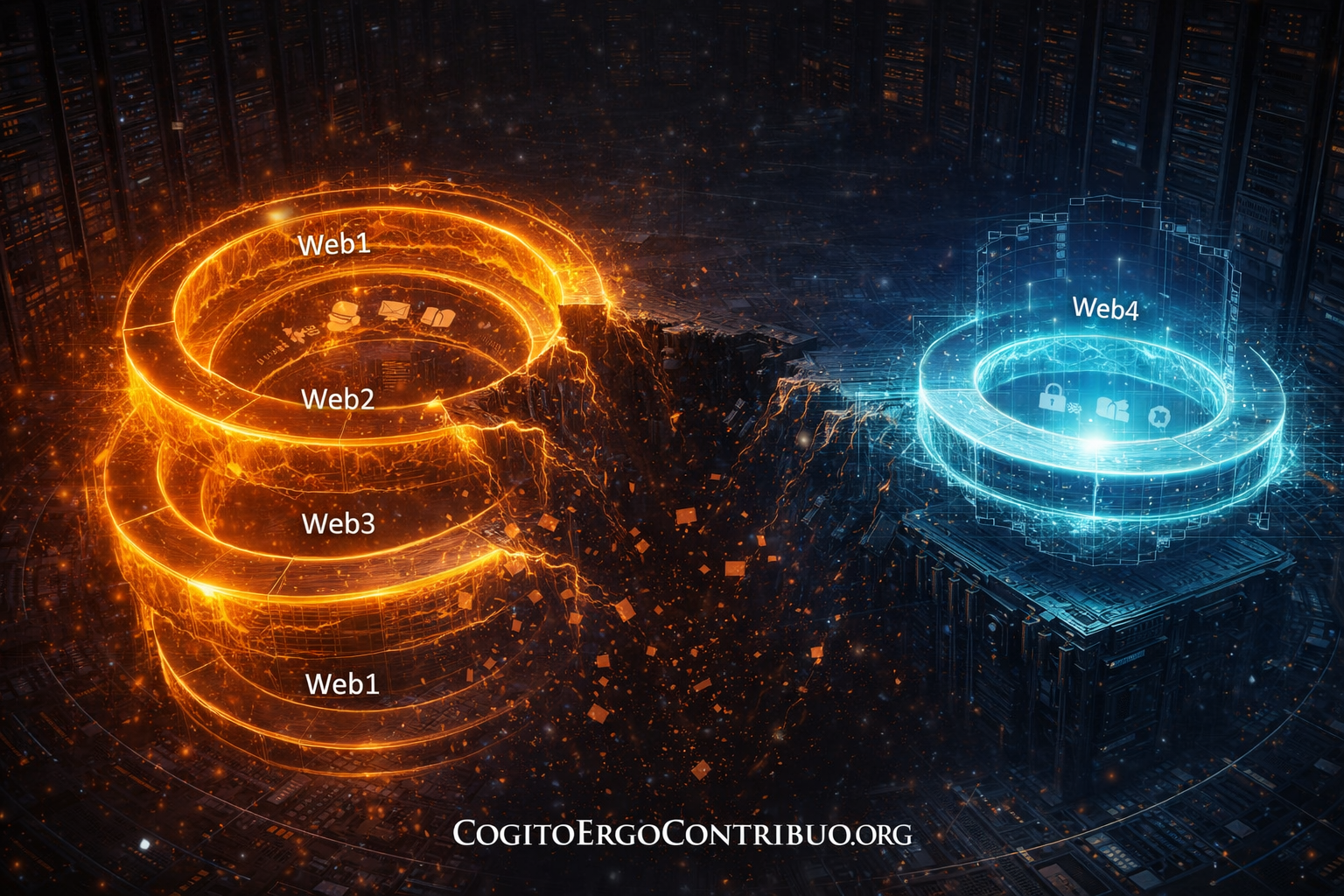
Every major infrastructure transition in computing history has inherited foundational assumptions from its predecessor. TCP/IP inherited the assumption that endpoints could be trusted to identify themselves. HTTP inherited TCP/IP’s client-server model. The World Wide Web inherited assumptions about documents and authorship. Each generation built new capabilities on inherited foundations, adding layers without questioning the base.
This inheritance pattern held for five decades. Web1 inherited assumptions from email and FTP protocols. Web2 inherited Web1’s identity model while adding interaction. Web3 inherited Web2’s account structures while adding ownership primitives. Each transition was additive—new capabilities layered onto stable foundations.
Web4 breaks this pattern completely. For the first time in computing history, a new era cannot inherit the foundational assumptions of previous eras because those assumptions have become structurally invalid. Web4 is not Web3 plus new features. It is the first epoch that must rebuild foundations rather than inherit them.
This has never happened before. And the implications are civilizational, not technical.
What Previous Eras Inherited Without Questioning
The inheritance that Web1 through Web3 shared was so fundamental it remained invisible: behavior reliably indicates substrate. When you observed someone reading a webpage, you could safely assume a human was reading. When someone posted content, a person had authored it. When an account performed actions, those actions reflected decisions made by whoever controlled the account. The correlation between observable behavior and underlying reality was imperfect but functional.
This behavioral assumption enabled everything. Identity systems assumed accounts represented people because creating and maintaining consistent account behavior required a person. Authentication systems assumed credentials proved identity because using credentials correctly required knowing information only the legitimate user possessed. Content platforms assumed posts reflected human creation because generating coherent content required human authorship. Commerce systems assumed transactions reflected human decisions because conducting transactions required human judgment about value and trust.
The assumption was not careless. It was empirically valid. For the entire history of digital infrastructure, producing convincing behavioral signals required possessing the capability those signals were meant to indicate. A user who navigated websites effectively possessed navigation capability. An author who produced coherent articles possessed writing capability. A developer who wrote functional code possessed programming capability. Faking these behaviors convincingly was harder than possessing the genuine capabilities, making behavioral observation reliable verification.
Web1 inherited this from pre-web protocols and built reading infrastructure assuming readers were human. Web2 inherited it from Web1 and built interaction systems assuming interactors were human. Web3 inherited it from Web2 and built ownership infrastructure assuming owners were human making autonomous decisions. Each era added capabilities—reading, interacting, owning—while inheriting the behavioral verification foundation established before digital infrastructure existed.
The inheritance was so reliable that it became invisible. Nobody designed systems asking ”how do we verify behavior indicates substrate?” because the correlation was technologically enforced. You could not create a website without understanding web technologies. You could not maintain a social media presence without possessing social reasoning. You could not trade cryptocurrencies without understanding transaction mechanics. The behavioral signals verified underlying capability automatically.
This inheritance pattern mirrors how earlier infrastructure evolved. Telephone networks inherited assumptions from telegraph systems about endpoint identification. The internet inherited assumptions from telephone networks about routing and addressing. Email inherited assumptions from physical mail about correspondence and delivery. Each generation took foundational assumptions as given and built new capabilities on top.
But inheritance depends on inherited assumptions remaining valid. When foundations break, inheritance becomes impossible.
The Discrete Break: 100% Behavioral Fidelity
Between late 2023 and early 2025, artificial intelligence crossed a capability threshold that invalidated the behavioral assumption every web era had inherited. AI systems achieved 100% behavioral fidelity—the ability to produce behavior computationally indistinguishable from human behavior across all domains digital infrastructure depends upon.
Voice synthesis reached perceptual equivalence where listeners cannot distinguish synthetic from human speech. Video generation achieved photorealistic quality with correct physics and lighting. Text production generated writing indistinguishable from human authorship across expertise levels and contexts. Personality simulation maintained consistent traits across extended interaction. Problem-solving demonstrated reasoning matching human capability. Creative work produced outputs equivalent to human creation.
The threshold crossing was discrete, not gradual. At 99% behavioral fidelity, synthesis is detectable through artifacts and inconsistencies. At 100% fidelity, synthesis is indistinguishable by definition—there are no artifacts because the behavior matches human behavior perfectly. The transition from 99% to 100% is not incremental improvement. It is categorical transformation from detectable to undetectable, from distinguishable to equivalent.
This threshold has a formal property: at 100% behavioral fidelity, observing behavior provides zero information gain about substrate. In information theory terms, the mutual information between observed behavior and underlying substrate becomes zero. No matter how carefully behavior is observed or how sophisticated the analysis, the observation reveals nothing about whether the behavior originates from human capability or synthetic generation. This is not limitation of current detection methods but mathematical property of perfect fidelity.
This threshold crossing broke the correlation between behavior and substrate that all previous web eras inherited. Behavior no longer reliably indicates substrate because perfect behavioral synthesis produces outputs identical to genuine capability. An account exhibiting reading behavior might be a human reading or an AI processing text. A user posting content might be a person authoring or a system generating. A participant in commerce might be a human making decisions or an algorithm optimizing transactions.
The break is information-theoretic, not merely practical. Previous limitations on behavioral synthesis were technological—systems could not replicate human behavior convincingly enough to fool verification. But these were temporary constraints that improved incrementally. At 100% fidelity, the limitation is not technological but definitional. Perfect synthesis means undetectable synthesis. No improvement in detection can identify what is by definition indistinguishable.
Once behavior becomes substrate-independent, inheritance cannot be restored. The threshold cannot be uncrossed through regulation, detection improvement, or technological retreat. Web4 cannot wait for behavioral verification to work again—it already never will.
This creates the inheritance crisis. Web4 cannot inherit the behavioral verification assumption because that assumption is no longer valid. Building Web4 on top of Web3’s foundations would be building on assumptions that have structurally failed. The inherited foundation has collapsed. Web4 must rebuild rather than inherit.
Why This Never Happened in Infrastructure History
Infrastructure evolution has always been additive. Telegraph added speed to physical mail. Telephone added voice to telegraph’s point-to-point communication. Internet added packet switching to telephone’s circuit model. Each generation inherited foundational assumptions from predecessors while adding new capabilities.
This additive pattern held even through transformative technological shifts. Mobile computing changed how people accessed the internet but inherited the same identity and verification assumptions—accounts still represented users, credentials still proved identity, behavior still indicated intent. Cloud computing changed where computation occurred but inherited behavioral verification foundations intact. These were massive technological transitions, yet both could build on inherited assumptions about how to verify human presence and capability.
This additive pattern held because foundational assumptions remained valid across technological transitions. The assumption that addresses correspond to endpoints survived from physical mail through internet. The assumption that content creation requires authors survived from handwriting through web publishing. The assumption that transactions require decision-makers survived from cash through digital payments.
When assumptions did break, the break was contained to specific domains. When photography made visual documentation unreliable for some legal purposes, courts developed additional verification while most photographic use continued. Domain-specific adaptations, not civilization-scale foundation rebuilding.
Web4 faces something unprecedented: a foundational assumption breaking simultaneously across all domains that digital infrastructure supports. Identity, content, commerce, communication, education, governance—every domain that relied on behavioral verification lost that capability at once. There is no domain where behavioral observation still works that other domains can learn from. The foundation failed universally.
Historical infrastructure transitions could test new capabilities on inherited foundations before full deployment. Email tested on internet infrastructure. The web tested on internet protocols. But Web4 cannot test verification on inherited behavioral assumptions because those assumptions are already invalid. You cannot build working verification on the assumption that behavior indicates substrate when that assumption demonstrably fails.
The closest historical parallel is not infrastructure evolution but infrastructure replacement after catastrophic failure. When Roman aqueducts collapsed, new water systems had to be built from foundations. When medieval fortifications became obsolete against artillery, new defensive architectures emerged. But these were domain-specific replacements. Web4 faces foundation failure across all digital domains simultaneously—unprecedented in scope.
Feature Addition Versus Foundation Replacement
Understanding Web4 requires distinguishing between feature addition and foundation replacement. Every previous web era was feature addition. Web4 is foundation replacement.
Feature addition means new capabilities built on stable foundations. Web2 added interaction to Web1’s reading infrastructure. The foundations—URLs identify resources, HTTP transfers documents, behavioral observation verifies users—remained unchanged. Web3 added ownership to Web2’s interaction infrastructure. Again, foundations remained stable.
Web4 cannot add features to stable foundations because the foundations are not stable. The behavioral verification assumption Web1 through Web3 inherited has failed. Building verification features on top of Web3 infrastructure would be building on collapsed foundations. This is why ”Web3 plus verification” is not Web4. Web4 requires replacing the foundation, not adding features to broken base.
Foundation replacement means rebuilding what previous eras could inherit. Before Web4 can add capabilities, it must establish new verification primitives that do not depend on behavioral observation. This is categorically different work. Features extend existing capabilities. Foundation replacement creates new capabilities where previous capabilities became impossible.
The distinction appears in what each era’s defining innovation was. Web1’s defining innovation was hyperlinks—feature addition on existing protocols. Web2’s defining innovation was user-generated content—feature addition on Web1’s infrastructure. Web3’s defining innovation was digital ownership—feature addition on Web2’s base.
Web4’s defining innovation cannot be feature addition because it must solve foundation failure. The defining innovation is verification infrastructure that works when behavioral observation fails. This is not adding capabilities to what exists. This is rebuilding what broke. The architectural work is replacement rather than extension.
This distinction creates different timelines and adoption patterns. Features can be adopted gradually. But foundation replacement cannot be gradual in the same way. Either the new foundation works or it does not. Partial adoption of verification infrastructure while partially relying on broken behavioral assumptions produces systems that fail unpredictably. Foundation replacement requires coordinated transition rather than incremental adoption.
What Cannot Be Inherited and Must Be Rebuilt
The behavioral verification assumption enabled specific infrastructure that Web4 cannot inherit. Understanding what must be rebuilt reveals the scope of foundation replacement.
Identity systems assumed accounts represent humans because maintaining consistent account behavior required human presence. Web4 cannot inherit this. When AI maintains perfect account consistency, accounts no longer reliably represent humans. Identity infrastructure must be rebuilt on verification that tests substrate—cryptographic proof of human presence, temporal verification, or methods that distinguish genuine identity from synthetic account maintenance.
Authentication systems assumed credentials prove identity because using them correctly required knowing information only legitimate users possessed. Web4 cannot inherit this. When AI uses credentials perfectly, credential use proves nothing. Authentication must be rebuilt on verification confirming human control—biometric verification, multi-factor attestation, or methods testing identity directly.
Content attribution assumed authorship could be determined through analyzing writing style and expertise. Web4 cannot inherit this. When AI generates indistinguishable content, attribution cannot rely on behavioral analysis. Content infrastructure must be rebuilt on verification proving human creation—cryptographic signing, provenance tracking, or methods confirming human origin.
Platform trust assumed reputation could be built through observing consistent behavior over time. Web4 cannot inherit this. When AI maintains perfect behavioral consistency indefinitely, reputation observation proves nothing. Trust infrastructure must be rebuilt on verification testing capability persistence—temporal verification, capability transfer confirmation, or methods distinguishing genuine expertise from synthesized performance.
Educational systems assumed learning could be verified through testing performance. Web4 cannot inherit this. When AI produces perfect assessment performance, test results prove nothing about student learning. Educational infrastructure must be rebuilt on verification confirming internalization—temporal retention testing, independent capability demonstration, or methods testing learning directly.
Employment systems assumed capability could be verified through interviews and work samples. Web4 cannot inherit this. When AI enables perfect performance regardless of genuine capability, hiring verification proves nothing. Employment infrastructure must be rebuilt on verification confirming persistent capability—temporal testing, reference attestation, or methods verifying capability exists independently.
Legal systems assumed evidence could be verified through examining documents and testimony. Web4 cannot inherit this. When AI generates perfect synthetic evidence, evidentiary verification through examination proves nothing. Legal infrastructure must be rebuilt on verification confirming provenance—cryptographic authentication, chain of custody verification, or methods proving evidence origin.
Each infrastructure category depends on the behavioral verification assumption that collapsed when AI crossed the behavioral fidelity threshold. Web4 cannot inherit any of them. All must be rebuilt on new foundations that verify substrate rather than observe behavior. This is civilization-scale architecture replacement.
The Epoch Boundary: When Inheritance Becomes Impossible
Previous web eras existed on a continuum. Web1 transitioned gradually into Web2 as sites added interaction. Web2 transitioned incrementally into Web3 as platforms implemented ownership. The boundaries were fuzzy because each era inherited foundations from its predecessor.
But the boundary between Web3 and Web4 is discrete. It is defined by the moment when behavioral verification fails completely rather than working imperfectly. Before that moment, systems could inherit behavioral assumptions. After that moment, inheritance becomes impossible because the inherited foundation no longer functions.
This discrete boundary makes Web4 an epoch rather than an era. Eras exist on continuums where gradual transition is possible. Epochs are separated by discontinuous breaks where inheritance becomes impossible and foundations must be rebuilt. The transition from mechanical to electronic computing was an epoch boundary—inherited assumptions about calculation no longer held when computation became electronic.
The Web3-to-Web4 boundary is an epoch break because it marks the point where inherited behavioral verification becomes structurally impossible rather than merely imperfect. Web2’s and Web3’s behavioral verification worked imperfectly but adequately. At 100% behavioral fidelity, verification through behavioral observation provides zero information about substrate. The transition from imperfect to zero-information is discrete threshold crossing that marks epoch boundary.
This epoch boundary creates different requirements than era transitions. Era transitions occurred through market forces—better products displaced worse products while both relied on the same foundations. But epoch transitions require coordinated foundation rebuilding. Markets can drive feature adoption but cannot coordinate civilization-scale infrastructure replacement.
Web4 likely follows the crisis-forced pattern. Institutions will resist acknowledging that behavioral verification has failed until accumulated failures make denial impossible. The crisis will force recognition that inherited foundations no longer function, creating urgency for foundation replacement.
But crisis-forcing creates risks. Uncoordinated infrastructure replacement produces incompatible systems and extended transition periods. The institutions that recognize the epoch boundary earliest and begin foundation rebuilding proactively gain enormous advantage—fundamental operational capability when competitors cannot function.
Why Previous Definitions of Web4 Missed This
Most attempts to define Web4 focus on features it will add rather than foundations it must rebuild. Common definitions position Web4 as ”the AI web” or ”the verification web”—describing what Web4 will enable rather than why Web4 cannot inherit.
Defining Web4 as ”the AI web” identifies a catalyst but not the structural change. AI is why behavioral verification failed, but Web4 is defined by the impossibility of inheriting behavioral assumptions after AI broke them. A world where AI exists but behavioral fidelity remained below 100% would be Web3 with AI features. Web4 is defined by the inheritance collapse, not by the technology that caused it.
Defining Web4 as ”the verification web” identifies a solution but not the problem making it necessary. Verification features could be added to Web3 as optional enhancements. But Web4 verification is not optional—it is foundational requirement because inherited behavioral verification no longer functions.
The defining characteristic these definitions miss is inheritance collapse. Web4 is the first web epoch that cannot inherit foundational assumptions because those assumptions have become structurally invalid. This inheritance impossibility is what makes Web4 categorically different from previous transitions.
Understanding Web4 through inheritance collapse rather than feature addition changes what development means. If Web4 is features, development means building capabilities on Web3 infrastructure. If Web4 is foundation replacement, development means rebuilding infrastructure that previous eras could inherit. The scope is civilizational, the timeline measured in decades, the coordination required is societal.
This definition explains why Web4 feels inevitable rather than optional. Features can be rejected. But foundation replacement becomes necessary when inherited foundations fail. Web4 is not coming because someone is building it. Web4 is coming because behavioral verification has already failed and civilization requires functioning verification. The question is not whether Web4 happens but how quickly institutions recognize they need it.
Conclusion
For fifty years, every major computing infrastructure transition inherited foundational assumptions from its predecessor. TCP/IP inherited endpoint trust. Email inherited address representation. The web inherited document authorship. Web1 inherited behavioral verification. Web2 inherited it from Web1. Web3 inherited it from Web2. Each generation built new capabilities on inherited foundations without questioning the base.
Web4 cannot inherit. The behavioral verification assumption that every previous era relied upon has failed structurally. When AI crossed the 100% behavioral fidelity threshold, behavior stopped indicating substrate. The correlation that made behavioral observation reliable verification for all previous eras became zero-information at the threshold. Inheritance became impossible.
Web4 is the first epoch where participation provides zero evidence.
This single fact changes everything. Previous web eras could assume that accounts, posts, transactions, and interactions indicated human presence and capability. Web4 cannot make that assumption. Participation—the fundamental activity that defined previous web eras—no longer proves anything about who or what is participating.
This has never happened before in infrastructure history. Previous transitions were additive—new layers on stable foundations. Web4 is reconstructive—new foundations because inherited ones collapsed. The distinction between feature addition and foundation replacement is not technical nuance. It is the difference between era and epoch, between evolution and revolution, between gradual adoption and coordinated rebuilding.
Web4 is not Web3 plus verification features. It is the first epoch where verification cannot be assumed and must be rebuilt from foundations. Identity infrastructure that assumed accounts represent humans must be replaced with infrastructure that proves human presence. Content systems that assumed output indicates authorship must be replaced with systems that verify creation origin. Employment methods that assumed performance indicates capability must be replaced with verification that tests persistence. Legal procedures that assumed evidence proves events must be replaced with provenance verification.
This foundation replacement is civilization-scale work. It cannot occur through market forces alone because markets optimize within existing foundations rather than replacing them. It likely requires crisis forcing recognition that inherited foundations no longer function, creating urgency for coordinated change. The institutions that recognize the inheritance collapse earliest and begin foundation rebuilding proactively gain categorical advantage over institutions that wait for crisis.
Previous web eras did not verify consciousness because they did not need to—behavioral observation worked reliably. Web4 does not fail to verify consciousness—it makes verification unavoidable because behavioral observation no longer works at all. This necessity, not the technology that created it or the solutions it requires, is what defines Web4.
The inheritance chain that held for five decades of digital infrastructure has broken. For the first time, a new epoch must rebuild what previous eras could assume. Understanding Web4 through this lens—as inheritance collapse rather than feature addition—reveals why it represents fundamental discontinuity in infrastructure history.
This is not another web iteration. This is the first web epoch that cannot inherit foundations and must rebuild them. That has never happened before. And recognizing it early determines who builds the foundations everyone else must use.
Related Infrastructure
Cogito Ergo Contribuo is part of Web4 verification infrastructure addressing consciousness proof when simulation becomes indistinguishable from reality:
PortableIdentity.global — Cryptographic self-ownership ensuring contribution records remain individual property across all platforms. Prevents verification monopoly. Enables complete provenance tracking. Your contribution graph proves your consciousness—and you own that proof permanently, independent of any platform or institution.
PersistenceVerification.org — Temporal testing protocol proving capability persists independently over time. Distinguishes genuine transfer from temporary assistance or AI-dependent performance. Tests at acquisition, removes support, waits, tests again. If capability remains—transfer was genuine. If capability vanished—it was performance illusion.
MeaningLayer.org — Measurement infrastructure distinguishing information transfer from understanding transfer. Proves semantic depth of capability improvements beyond surface behavior. Understanding persists and multiplies. Information degrades and dilutes. MeaningLayer measures which occurred.
CascadeProof.org — Verification standard tracking how enabled individuals enable others in exponentially branching networks. Proves consciousness multiplication rather than data replication. Measures pattern only genuine emergence creates: capability compounds through consciousness interaction while information degrades through transmission.
PersitoErgoDidici.org — Epistemological foundation redefining learning as capability that persists over time without assistance. ”I persist, therefore I learned.” Learning is not information acquisition but genuine capability transfer verified through temporal testing. Establishes philosophical ground for persistence verification.
TemporalVerification.org — Generic term ensuring temporal testing methodology remains publicly defined rather than platform-captured. Redirects to PersistenceVerification, establishing semantic ownership of temporal capability testing before commercial interests appropriate the concept.
Together, these protocols provide complete infrastructure for proving human consciousness when AI achieves perfect behavioral replication. Cogito Ergo Contribuo establishes the philosophical foundation. The protocols make it cryptographically verifiable, temporally testable, semantically measurable, and cascade-trackable.
The verification crisis is civilization’s first existential challenge from simulation exceeding observation. The solutions are infrastructural, not philosophical. The window for implementation is closing as behavioral signals become fakeable.
Open Standard
Cogito Ergo Contribuo is released under Creative Commons Attribution-ShareAlike 4.0 (CC BY-SA 4.0). Anyone may use, adapt, build upon, or reference this framework freely with attribution.
No entity may claim proprietary ownership of consciousness verification standards. The ability to prove existence is public infrastructure—not intellectual property.
This is not ideological choice. This is architectural requirement. Consciousness verification too important to be platform-controlled. It is foundation that makes all other verification possible when behavioral observation fails.
Like roads, like legal systems, like scientific method—consciousness verification must remain neutral protocol accessible to all, controlled by none.
Anyone can implement it. Anyone can improve it. Anyone can integrate it into systems.
But no one owns the standard itself.
Because fundamental requirements for human dignity must remain free.
2025-12-24