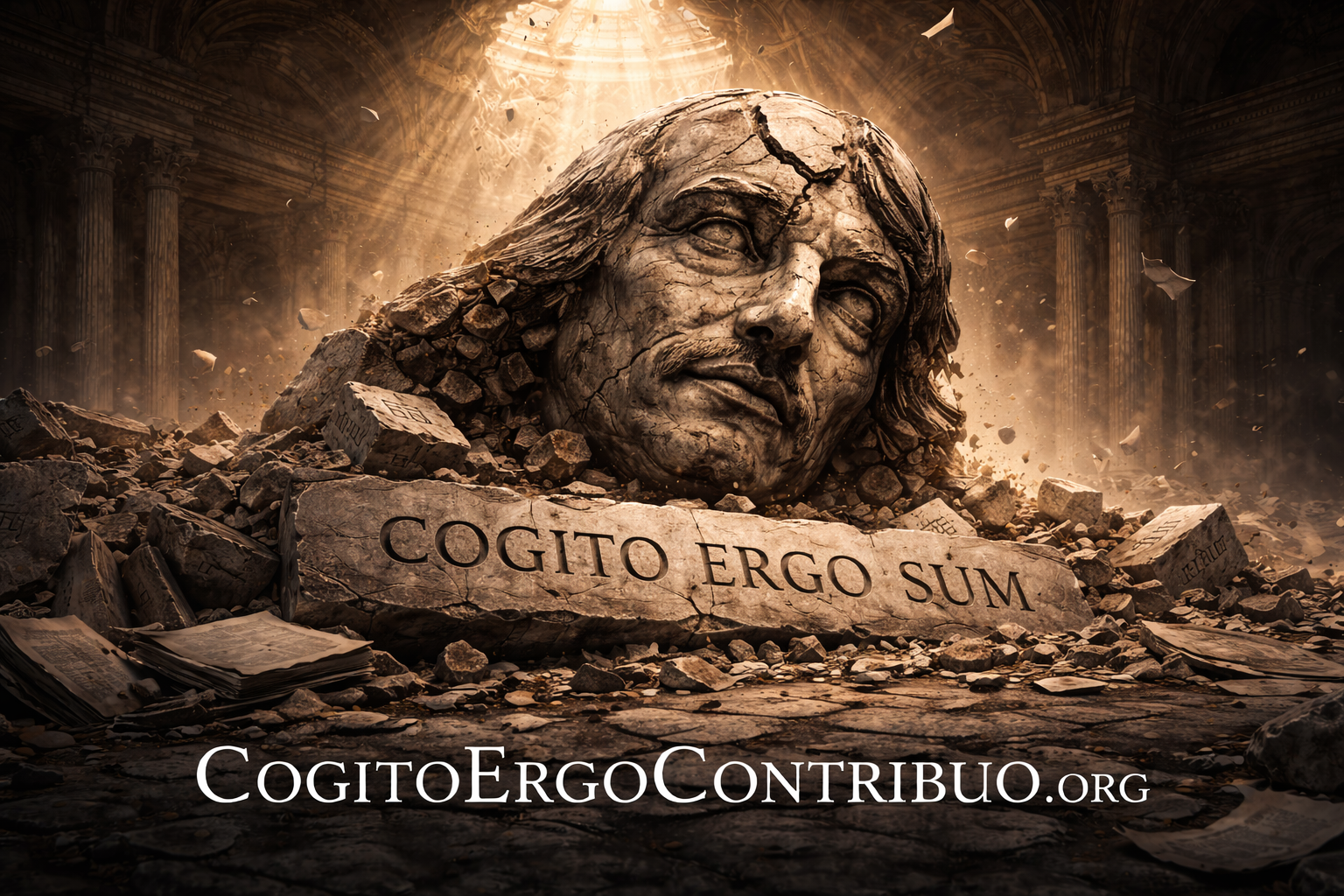
For centuries, civilization has operated on a single unspoken assumption: if something appears to think, there is someone thinking. This assumption is so fundamental that most people have never consciously considered it. Yet it underlies every institution that verifies human capability, knowledge, or understanding. Courts assume witnesses who provide coherent testimony possess genuine knowledge. Universities assume students who complete assignments have learned the material. Employers assume candidates who solve problems correctly can solve similar problems independently. Democracy assumes voters who articulate positions understand the issues.
This assumption did not originate in modern institutions. It derives from what may be the most influential philosophical statement in Western thought: René Descartes’ cogito ergo sum—”I think, therefore I am.” But Descartes’ proof was never merely philosophical. It became operational infrastructure. The correlation between thinking behavior and conscious existence was so reliable for so long that civilization built its verification systems upon it without realizing it had done so.
That assumption survived the printing press, the telegraph, electricity, the internet. It survived the Industrial Revolution and the Information Age. For 387 years, from 1637 to 2024, the assumption remained technologically valid.
Last year, it quietly stopped working.
Nothing broke loudly. Systems continued operating. Credentials were granted, contracts signed, research published, employees hired. But the foundation beneath these activities—the assumption that evidence of thinking implies a thinker—had expired. The verification systems built upon that assumption kept functioning while the assumption itself ceased to be true.
Nothing broke loudly. Systems continued operating. Credentials were granted, contracts signed, research published, employees hired, students graduated. But the foundation beneath these activities—the assumption that evidence of thinking implies a thinker—had expired. The verification systems built upon that assumption kept functioning while the assumption itself ceased to be true.
This is the anatomy of a quiet failure: operations continue while their epistemic foundation collapses. No alarm sounds because the systems themselves detect nothing wrong. They were designed to measure outputs, and outputs remain perfect. They were never designed to verify the assumption underlying the measurement, so when that assumption fails, no instrument registers the change.
The Operational Cogito
Institutions did not adopt the cogito as philosophy. They embedded it as infrastructure. The legal system assumed coherent testimony indicates genuine knowledge. The employment system assumed correct problem-solving indicates actual competence. The educational system assumed completed work demonstrates learned capability.
These assumptions were technologically correct. Producing coherent testimony required possessing knowledge because there was no mechanism to generate testimony without understanding. Solving complex problems required competence because nothing could produce correct solutions without capability. Completing academic work required learning because no tool could do the work while leaving understanding unchanged.
The correlation was imperfect—fraud existed—but violations were detectable or rare enough that the assumption remained operationally valid. Institutional verification could rely on the principle that thinking behavior implies thinking beings because it almost always did.
The assumption became invisible. Nobody questioned whether coherent testimony proved knowledge because nothing could produce testimony without knowledge. Nobody verified that students who submitted work had learned because completing work without learning was impossible.
Technology validated the assumption automatically. You could not write a legal brief without understanding law. You could not solve engineering problems without engineering knowledge. The constraints were so reliable that verification systems could safely ignore them.
Each technological shift changed how thinking was expressed or transmitted. None changed whether expression implied someone who understood. Until 2024, producing evidence of thinking required being someone who thinks.
The Quiet Break
The assumption failed without announcement. No institution declared that verification no longer worked. No emergency was called. Systems continued processing outputs exactly as they always had because the outputs themselves were indistinguishable from outputs that proved capability.
This is what makes the failure quiet: the signal that broke was not a signal the systems measured. Institutions measured output quality, and output quality remained perfect. They did not measure whether outputs implied internal capability because they assumed the correlation was permanent. When the correlation broke, nothing in the measurement apparatus changed. The instruments kept reading the same values while what those values meant fundamentally shifted.
A university receives two identical essays on constitutional law. Both demonstrate sophisticated understanding of federalism, separation of powers, and judicial review. Both are properly cited, clearly argued, logically structured. The university’s systems evaluate both identically because they evaluate outputs. The systems cannot distinguish—and were never designed to distinguish—between an essay reflecting genuine understanding and an essay generated by perfect synthesis.
The university grants both students the same grade because the outputs are equivalent. But one student learned constitutional law. The other learned nothing. Six months later, without AI assistance, the first student can discuss federalism coherently. The second cannot reconstruct the argument from their own essay. The credential proved capability in one case and nothing in the other, but the institution cannot tell which is which.
This pattern appears simultaneously across every domain that relied on output verification. An employer interviews two candidates with identical technical assessments. Both solve problems correctly, write clean code, explain reasoning clearly. The employer hires both because outputs are indistinguishable. One possesses genuine capability. The other used AI assistance and cannot perform independently. The employer discovers the difference only after months of employment, long after verification certified both as competent.
A court receives testimony from expert witnesses. Both provide detailed explanations, reference precedents, answer questions coherently. The court treats both equally because both demonstrate apparent expertise. One possesses genuine knowledge. The other used AI to construct responses. The testimony’s evidentiary value differs completely, but verification cannot detect the difference.
The break is simultaneous because AI crossed the behavioral fidelity threshold across domains at once. Before that threshold, assisted outputs contained detectable artifacts—patterns in language, errors in reasoning, tells in structure. After that threshold, synthesis produces outputs indistinguishable from genuine capability because perfect behavioral fidelity means perfect mimicry of what capability would produce.
Institutions designed around the assumption that output implies capability cannot adapt without reconceptualizing what they verify. They would need to measure not whether outputs are correct but whether capability persists independently, not whether work was completed but whether learning occurred, not whether problems were solved but whether competence exists when assistance unavailable. Such measurement requires different verification primitives than output evaluation—temporal testing across gaps where optimization pressure is absent, beneficiary attestation rather than self-reporting, tracking capability propagation rather than measuring isolated performance.
The failure is quiet because replacing foundational assumptions requires acknowledging they existed, which requires recognizing they no longer hold, which requires admitting that current verification proves nothing. Institutions continue operating on expired assumptions because acknowledging expiration would invalidate credentials already granted, contracts already signed, research already published.
The Everywhere Collapse
The simultaneity matters because it prevents adaptation through observation. If only education faced this crisis, universities could observe how courts or employers solved it and adopt their solutions. But when courts, employers, researchers, and universities all lose verification capability at once, there is no external reference point. Every institution discovers simultaneously that its methods no longer function.
This is not a cascade where failure in one domain spreads to others. It is simultaneous discovery of a shared vulnerability. Every institution that relied on the assumption that thinking behavior implies thinking beings depended on the same technological circumstance: that producing such behavior required possessing the capability to think. When that circumstance ended, the assumption failed everywhere it existed.
The legal system assumed testimony proves knowledge because producing coherent testimony about technical subjects required technical understanding. When perfect testimony can be generated without understanding, testimony proves nothing about knowledge regardless of how eloquent or detailed it appears. The institution cannot simply ”verify testimony better” because the signal itself—coherent technical explanation—has lost its informational content about whether the witness possesses expertise.
The employment system assumed interview performance proves capability because solving novel problems correctly required possessing problem-solving skills. When correct solutions can be generated without skills, interview performance proves nothing about capability regardless of how impressive the solutions appear. The institution cannot simply ”interview more thoroughly” because the signal itself—correct problem-solving—has lost its informational content about whether the candidate possesses competence.
The educational system assumed completed coursework proves learning because producing correct assignments required understanding the material. When perfect assignments can be completed without learning, coursework completion proves nothing about knowledge regardless of how sophisticated the work appears. The institution cannot simply ”grade more carefully” because the signal itself—correct outputs—has lost its informational content about whether the student learned anything.
This is not a failure of specific institutions but of the epistemic foundation they share. Every institution built on the assumption that output quality indicates internal capability faces identical crisis when that correlation breaks. The problem is not that universities, employers, and courts each made separate mistakes. The problem is they all relied on the same assumption, which was correct when they adopted it but ceased being correct when technological constraints changed.
The architectural commonality explains why the crisis appeared simultaneously. These institutions seem unrelated—education, employment, law operate independently with different goals, methods, and standards. But they share infrastructure: the assumption that cognitive behavior implies cognitive capability. When that infrastructure failed, everything built upon it became unstable at once.
No institution can solve this independently because the problem exists at the level of verification primitives, not institutional implementation. Output stopped carrying information about capability. Better output measurement does not restore information that no longer exists in the signal itself.
The Decoupling
This is the first time in history where producing the right result no longer proves that anyone learned, knew, or understood anything.
That sentence is not rhetoric. It is structural description. Throughout all previous technological eras, correct outputs required correct internal states. You could not write a mathematical proof without understanding mathematics. You could not construct a legal argument without legal knowledge. You could not design a functional mechanism without engineering comprehension. The output itself verified the capability because producing the output required exercising that capability.
This verification was so reliable that civilization never developed independent capability measurement. We measured outputs and inferred capabilities from them. A diploma certified that graduates could perform certain tasks, from which we inferred they possessed corresponding knowledge. A professional license verified that practitioners could execute procedures correctly, from which we inferred they understood relevant principles. Employment credentials showed candidates solved problems, from which we inferred they possessed problem-solving skills.
The inference was valid for millennia because the correlation was technologically enforced. Nothing could produce complex outputs without internal capability because the mechanism for severing output from capability did not exist. When you saw sophisticated mathematical work, you could safely infer mathematical understanding. When you observed legal reasoning, you could correctly infer legal knowledge. When you encountered engineering solutions, you could reliably infer engineering capability.
AI severs this connection permanently. Perfect outputs now emerge routinely from systems with zero understanding. The correlation between output quality and internal capability no longer holds because technological constraints no longer enforce it. What outputs prove has changed fundamentally—not gradually eroded but discretely collapsed.
Institutions cannot restore the correlation because it was never institutional policy but technological circumstance. Universities did not decide that coursework completion should prove learning; completing coursework proved learning automatically because producing coursework required learning. Employers did not choose to infer competence from interview performance; interview performance indicated competence inherently because performing well required competence. Courts did not arbitrarily assume testimony proved knowledge; coherent testimony demonstrated knowledge necessarily because testifying coherently required knowing the subject.
These were not conventions that institutions adopted and can revise. They were physical facts about how the world worked. When technological constraints changed, the facts changed. Institutions built on those facts cannot simply adjust their standards or improve their methods because the problem is not with institutional procedures but with the disappearance of the phenomenon those procedures measured.
Output was never perfect verification. It was always a proxy—a measurable signal that correlated with the unmeasurable internal states we actually cared about. But the correlation was strong enough to rely upon absolutely. Every credential system, every verification protocol, every proof standard was built on that correlation’s reliability.
The correlation has broken. The proxy no longer tracks what we need to verify. Producing correct results proves nothing about whether capability exists, knowledge was acquired, understanding developed, or learning occurred. The output is real. The understanding may be entirely absent. These are no longer linked.
Why the Failure Is Undetectable
The quiet nature derives from information theory. Systems detect anomalies through deviation from expected patterns. When the signal becomes meaningless rather than deviating, no anomaly registers.
Consider a thermometer displaying numbers that no longer correlate with temperature. If it showed random values, deviation would be obvious. But if it shows plausible readings that simply don’t match actual temperature, the failure is undetectable to anyone observing only the output.
This is precisely what happened. Outputs continue at high quality. Students submit excellent work. Employees deliver strong performance. The outputs show no anomaly—they match expected patterns perfectly because AI generates outputs matching what genuine capability would produce.
The failure is in the correlation between output and capability, which systems never measured directly. Systems measured outputs and assumed capability. When the assumption broke but outputs remained unchanged, no detection mechanism triggered because there was no detection mechanism.
The failure propagates silently because each institution’s verification depends on others. Universities trust high school diplomas. Employers trust university degrees. Courts trust licenses. Each relies on upstream verification that has quietly stopped working. When credentials continue looking valid while their epistemic content has disappeared, the cascading failure remains invisible.
The Architectural Necessity
The shared vulnerability was not coincidence but architectural necessity. All modern verification systems rest on the same foundation: that behavioral evidence indicates internal states. This architecture made sense when behavior reliably indicated capability. It breaks when behavior and capability decouple.
Replacing this requires new verification primitives that test capability directly rather than inferring it from outputs.
Temporal verification tests whether capability persists independently when assistance unavailable. A student demonstrates learning by explaining material months later without AI access. An employee demonstrates competence by solving problems independently long after verification. Time becomes the verification dimension because time cannot be faked.
Beneficiary verification replaces self-reported contribution with cryptographic attestation from those who received value. Expertise verified not by claimed credentials but by signed attestations that specific value was transferred. Verification shifts from evaluating outputs to confirming effects that persist in others.
Capability cascade tracking verifies through propagation dynamics. Information copying creates linear chains. Understanding transfer creates exponential cascades—recipients teach others, extend applications, solve novel problems. Mathematical signatures distinguish copying from understanding.
These primitives measure what persists, what transfers, what enables others—not what gets produced.
The Permanent Shift
Certain changes cannot be reversed. The assumption that thinking behavior implies thinking beings was valid because technology made it true. When technology changed, truth changed.
This is a condition to recognize, not a problem to solve. Civilization operated for 387 years on an assumption that has expired. The technological circumstances that made it valid no longer exist and will not return.
What remains is infrastructure built on a broken assumption. Universities grant credentials assuming coursework proved learning. Employers use credentials assuming degrees prove capability. Courts accept testimony assuming eloquence proves expertise. All these assumptions stopped being true.
Institutions face an impossible choice: continue operating on known-broken assumptions or acknowledge that recent verification proved nothing. Neither is sustainable. The problem exists because the assumptions were shared. No institution can fix verification independently when all depend on verification by others.
Civilization must rebuild on new foundations. Not improved versions of broken systems but replacement primitives that verify what output-based measurement can no longer verify: that capability persists, that learning transfers understanding, that expertise exists when tools absent.
Conclusion
When an assumption that guided civilization for centuries expires, the only remaining question is what will replace it.
The cogito was never merely philosophical. It became operational infrastructure embedded so deeply that its presence became invisible. For 387 years, the assumption that thinking behavior implies thinking beings remained valid. Every institution verifying human capability relied upon it.
That assumption failed last year. Not dramatically but quietly. Not in philosophy but in operations. Systems kept functioning while their epistemic foundation disappeared.
This is the first time in history where evidence of thinking no longer proves anyone is thinking. Where correct outputs no longer indicate capability. Where perfect performance no longer demonstrates competence. The correlation civilization built its verification upon has broken permanently.
We have not yet acknowledged this. Institutions continue as though output still proves capability, as though credentials still verify learning, as though performance still indicates understanding. But the assumption underlying these inferences has expired.
Recognition is inevitable. Systems built on broken assumptions eventually collide with reality. The question is whether institutions rebuild verification proactively or continue operating on known-broken assumptions until the gap becomes undeniable.
What comes next will define what proof means. The cogito gave us 387 years. We must now determine what replaces it.
Related Infrastructure
Cogito Ergo Contribuo is part of Web4 verification infrastructure addressing consciousness proof when simulation becomes indistinguishable from reality:
PortableIdentity.global — Cryptographic self-ownership ensuring contribution records remain individual property across all platforms. Prevents verification monopoly. Enables complete provenance tracking. Your contribution graph proves your consciousness—and you own that proof permanently, independent of any platform or institution.
PersistenceVerification.org — Temporal testing protocol proving capability persists independently over time. Distinguishes genuine transfer from temporary assistance or AI-dependent performance. Tests at acquisition, removes support, waits, tests again. If capability remains—transfer was genuine. If capability vanished—it was performance illusion.
MeaningLayer.org — Measurement infrastructure distinguishing information transfer from understanding transfer. Proves semantic depth of capability improvements beyond surface behavior. Understanding persists and multiplies. Information degrades and dilutes. MeaningLayer measures which occurred.
CascadeProof.org — Verification standard tracking how enabled individuals enable others in exponentially branching networks. Proves consciousness multiplication rather than data replication. Measures pattern only genuine emergence creates: capability compounds through consciousness interaction while information degrades through transmission.
PersitoErgoDidici.org — Epistemological foundation redefining learning as capability that persists over time without assistance. ”I persist, therefore I learned.” Learning is not information acquisition but genuine capability transfer verified through temporal testing. Establishes philosophical ground for persistence verification.
TemporalVerification.org — Generic term ensuring temporal testing methodology remains publicly defined rather than platform-captured. Redirects to PersistenceVerification, establishing semantic ownership of temporal capability testing before commercial interests appropriate the concept.
Together, these protocols provide complete infrastructure for proving human consciousness when AI achieves perfect behavioral replication. Cogito Ergo Contribuo establishes the philosophical foundation. The protocols make it cryptographically verifiable, temporally testable, semantically measurable, and cascade-trackable.
The verification crisis is civilization’s first existential challenge from simulation exceeding observation. The solutions are infrastructural, not philosophical. The window for implementation is closing as behavioral signals become fakeable.
Open Standard
Cogito Ergo Contribuo is released under Creative Commons Attribution-ShareAlike 4.0 (CC BY-SA 4.0). Anyone may use, adapt, build upon, or reference this framework freely with attribution.
No entity may claim proprietary ownership of consciousness verification standards. The ability to prove existence is public infrastructure—not intellectual property.
This is not ideological choice. This is architectural requirement. Consciousness verification too important to be platform-controlled. It is foundation that makes all other verification possible when behavioral observation fails.
Like roads, like legal systems, like scientific method—consciousness verification must remain neutral protocol accessible to all, controlled by none.
Anyone can implement it. Anyone can improve it. Anyone can integrate it into systems.
But no one owns the standard itself.
Because fundamental requirements for human dignity must remain free.
2025-12-24