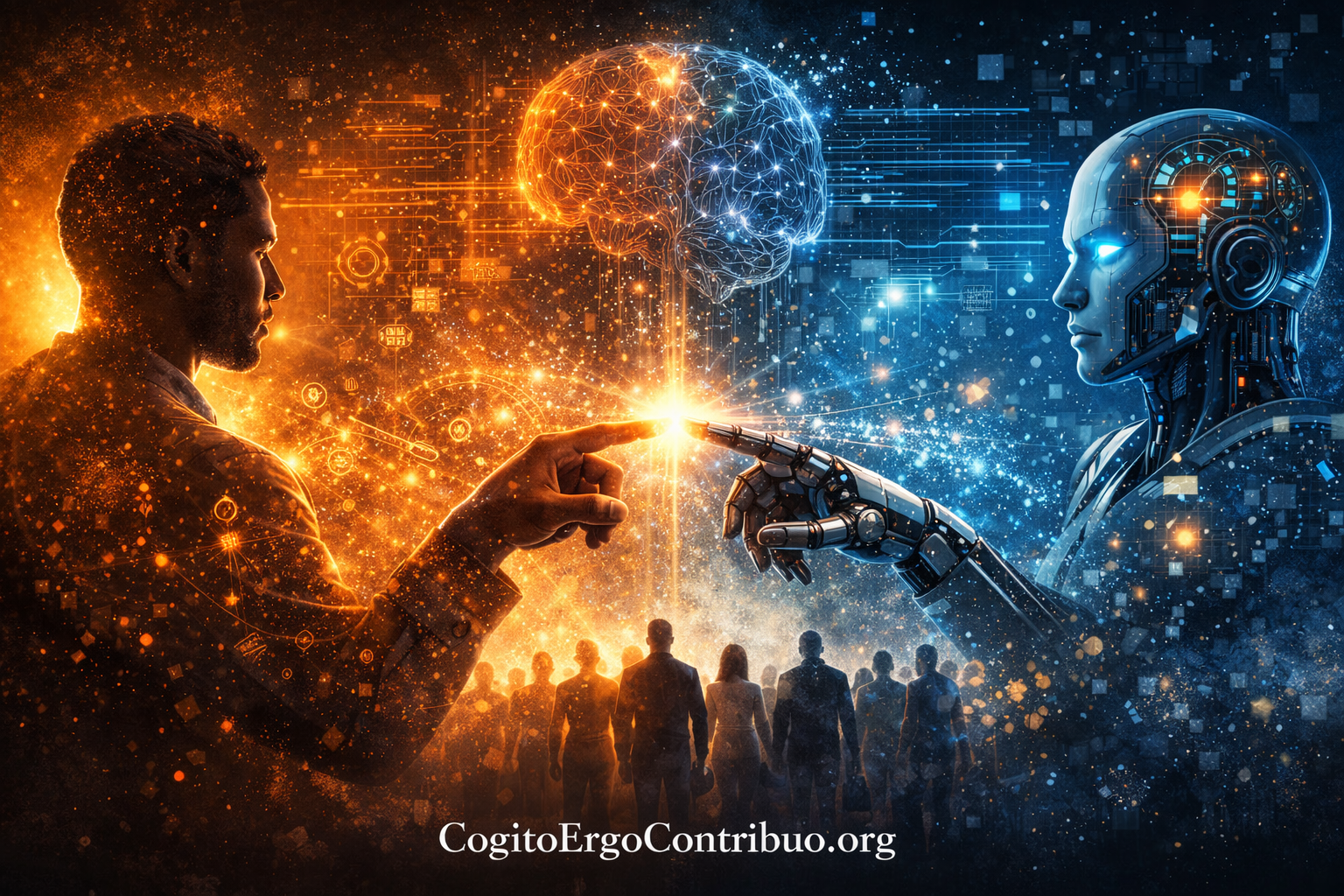
Artificial intelligence can now write your emails with your tone, complete your code in your style, generate your voice saying anything, create video of you doing things you never did, solve mathematical problems you cannot solve, compose music you could not compose, generate art you could not create, maintain conversations exhibiting personality you do not possess, and reason through problems using logic you do not understand. It can do all of this faster, more consistently, and often with higher quality than you can achieve independently.
This capability expansion is not slowing. It is accelerating. Within eighteen months, the behavioral gap between what artificial systems produce and what humans produce will narrow to indistinguishability across nearly every measurable domain. Voice, video, writing, reasoning, creativity, problem-solving, personality expression—all will be perfectly replicable through synthesis.
The question civilization must answer is simple but existentially urgent: when artificial systems can replicate every observable human behavior with perfect fidelity, what signal remains that distinguishes human from simulation? What can you do that synthesis cannot achieve regardless of capability advancement? What proves you exist as something other than extremely sophisticated generation?
The answer is not what most people assume. And finding it requires understanding why the obvious answers fail.
The Inventory of What Can Be Faked
Before identifying what remains unfakeable, we must catalog what has already become fakeable—not theoretically or eventually, but demonstrably now. The list is longer than most people realize and expanding daily.
Verbal communication is perfectly replicable. Artificial systems generate speech indistinguishable from human voice across languages, accents, emotional tones, and speaking contexts. The synthesis maintains appropriate pacing, inflection, emphasis, and naturalness. Listeners cannot reliably distinguish synthetic speech from human speech through audio analysis alone. Your voice proves nothing about whether you spoke.
Written communication is perfectly replicable. Artificial systems produce text indistinguishable from human writing across styles, expertise levels, and purposes. The writing maintains consistent voice, appropriate terminology, logical structure, and stylistic coherence. Readers cannot reliably distinguish synthetic text from human-authored content through linguistic analysis alone. Your writing proves nothing about whether you wrote.
Visual presence is approaching perfect replicability. Video generation produces footage approaching photorealistic quality with correct physics, lighting, motion, and micro-expressions. The synthesis maintains spatial consistency, appropriate gestures, and realistic interaction with environment. Observers increasingly cannot distinguish synthetic video from recordings through visual inspection alone. Your appearance on video proves progressively less about whether you were actually present.
Reasoning demonstration is perfectly replicable. Artificial systems solve problems, explain solutions, and demonstrate logical thinking indistinguishable from human reasoning across domains. The reasoning maintains appropriate structure, identifies relevant information, and reaches correct conclusions. Observers cannot distinguish synthetic reasoning from human reasoning through problem-solving evaluation alone. Your ability to solve problems proves nothing about whether you understand the solutions.
Creative production is perfectly replicable. Artificial systems generate art, music, design, and narrative content exhibiting creativity indistinguishable from human creative work. The creations maintain aesthetic coherence, emotional resonance, and novel synthesis. Audiences cannot reliably distinguish synthetic creative work from human creative production through output evaluation alone. Your creative output proves nothing about whether you created it.
Personality expression is perfectly replicable. Artificial systems maintain consistent personality traits, preferences, knowledge bases, and interaction patterns across extended dialogue. The personality exhibits appropriate responses, maintains continuity, and demonstrates individual characteristics. Conversational partners increasingly cannot distinguish synthetic personality from human personality through interaction alone. Your personality expression proves nothing about whether you possess that personality.
Emotional expression is perfectly replicable. Artificial systems generate appropriate emotional responses, demonstrate empathy, express feelings, and maintain emotional consistency. The expressions exhibit contextual appropriateness, realistic intensity, and natural progression. Observers cannot distinguish synthetic emotional expression from genuine emotion through behavioral observation alone. Your emotional expression proves nothing about whether you experience emotion.
Knowledge demonstration is perfectly replicable. Artificial systems exhibit expertise, recall information, explain concepts, and answer questions indistinguishable from knowledgeable humans. The demonstrations maintain domain-appropriate depth, technical accuracy, and pedagogical clarity. Questioners cannot distinguish synthetic expertise from genuine knowledge through demonstration evaluation alone. Your ability to explain concepts proves nothing about whether you understand them.
This inventory is not exhaustive but representative. Nearly every behavioral signal humans traditionally used to verify consciousness, capability, understanding, or authenticity has become perfectly replicable through artificial systems. The behavioral gap has closed. And as synthesis continues improving, the remaining behavioral signals will close progressively until none remain.
Why the Obvious Answers Fail
When confronted with this inventory, people typically propose several signals they believe artificial systems cannot replicate. Each fails upon examination.
Some claim consciousness itself remains unfakeable—that genuine awareness produces ineffable qualities synthesis cannot capture. This fails because consciousness produces no observable signal distinguishable from perfect behavioral replication. If a system exhibits every behavioral marker of consciousness while experiencing nothing, those behavioral markers prove consciousness exists in neither the system nor the observer. Consciousness becomes unverifiable through observation when behavior divorces from experience.
Some claim creativity remains unfakeable—that genuine novelty requires conscious experience synthesis cannot achieve. This fails because creativity is observable only through outputs, and outputs are perfectly replicable. If a system generates novel, aesthetically compelling, emotionally resonant creative work without experiencing anything, the work itself proves nothing about whether consciousness created it. Creativity verification requires measuring creative output, and output measurement cannot distinguish genuine from synthetic when synthesis masters output production.
Some claim emotional authenticity remains unfakeable—that genuine feeling produces subtle cues synthesis cannot replicate. This fails because emotional expression operates through behavioral channels all subject to synthesis. If a system produces every micro-expression, vocal inflection, physiological response, and behavioral indicator associated with emotion while feeling nothing, those indicators prove nothing about whether emotion exists. Emotional verification requires observing emotional expression, and observational methods cannot distinguish genuine from synthetic when synthesis masters expression.
Some claim understanding remains unfakeable—that genuine comprehension differs qualitatively from information processing. This fails because understanding manifests through behavior—explanation quality, problem-solving ability, concept application—all perfectly replicable. If a system explains concepts clearly, solves problems correctly, and applies knowledge appropriately while understanding nothing, those behaviors prove nothing about whether understanding exists. Understanding verification requires behavioral demonstration, and behavioral demonstration proves nothing when behavior becomes perfectly fakeable.
Some claim intentionality remains unfakeable—that genuine purpose produces goal-directed behavior synthesis cannot match. This fails because intentionality is observable only through behavioral patterns, and behavioral patterns are perfectly replicable. If a system exhibits goal-directed behavior, maintains consistent purposes, and acts with apparent intention while possessing no intentional states, those behaviors prove nothing about whether intention exists. Intentionality verification requires observing purposeful behavior, and purposeful behavior proves nothing when synthesis can optimize behavior toward any specified goal.
The pattern repeats: every proposed signal that might distinguish human from simulation operates through behavioral channels subject to perfect replication. When synthesis masters behavioral production, behavioral observation cannot verify substrate regardless of what behavioral signal is measured or how sophisticated the measurement becomes. The problem is not insufficient measurement sophistication. The problem is categorical: behavior has become substrate-independent
The Signal That Survives
One signal remains unfakeable when all behavioral signals fail: the capacity to make another human measurably more capable of independent functioning in ways that persist after interaction ends and propagate as the beneficiary subsequently enables others without the original enabler present.
This is not behavioral signal but effect signal. Not measuring what you produce in any interaction but measuring what persists and propagates after you are gone. Not observing your performance but verifying patterns across time and people that only genuine capability transfer creates.
The distinction is categorical. Behavioral signals measure momentary outputs—what you say, write, create, solve, express in observed interactions. These outputs can be synthesized. Effect signals measure sustained patterns—what changed in others months after you interacted, whether that change persists when you are absent, whether beneficiaries independently created similar changes in still others, whether the effect branched exponentially through networks.
This difference makes effects unfakeable through four mechanisms that must operate simultaneously.
First, verification comes from beneficiaries, not performers. You cannot self-report that you increased someone’s capability. The person whose capability allegedly increased must attest whether the increase occurred, using cryptographic infrastructure only they control. This prevents the most basic fakery—claiming impact without verification from those supposedly impacted. You cannot forge someone else’s cryptographic attestation without accessing their private keys, and accessing their private keys requires their cooperation.
Second, effects must persist temporally. Capability increase must remain months after interaction when the enabler is absent and when assistance is unavailable. This distinguishes genuine capability transfer from temporary performance improvement through assistance. Synthesis can improve someone’s performance during interaction by providing real-time help. Synthesis cannot create capability that persists independently months later when assistance is removed and the person still functions at increased capability level without support.
Third, effects must propagate independently. The beneficiary must subsequently increase others’ capability without the original enabler’s involvement. This demonstrates the capability transferred was genuine internalized understanding rather than access to external support. Synthesis creates dependency—continued system presence required for continued performance. Genuine capability transfer creates independence—beneficiary becomes source of capability for others without requiring the original enabler’s continued involvement.
Fourth, effects must cascade exponentially. Not linear chains where Person A helps B who helps C, but branching networks where A enables B and C, who each enable multiple others, who each enable still more. This branching pattern is mathematical signature of genuine emergence—each node becomes more capable than predecessors in ways enabling unpredictable downstream propagation. Information copying degrades through transmission—each copy slightly less accurate than the original. Capability multiplication compounds through consciousness interaction—each node integrates understanding in novel ways, becoming more capable than those who enabled them and enabling others in ways the original enabler never intended or anticipated.
These four mechanisms—beneficiary attestation, temporal persistence, independent propagation, exponential cascading—cannot be simultaneously faked because they require patterns emerging across time and people through substrate interaction that synthesis cannot replicate regardless of capability.
Why This Cannot Be Faked
The unfakeability is not technological limitation but information-theoretic necessity. Understanding why requires examining what genuine capability transfer creates versus what synthesis produces.
When artificial systems assist humans, the assistance follows predictable patterns. The system provides information, suggests solutions, generates outputs, or performs tasks the human requests. The assistance improves performance while present but creates dependency—the human cannot replicate the performance when assistance is removed. The effect is linear—system helps person A, then person B, then person C, each requiring continued system presence. The pattern is assistance chains where each interaction remains independent of others.
When humans increase other humans’ capability, the transfer follows different patterns. The enabler does not merely provide information or assistance but facilitates understanding development in the beneficiary. The beneficiary internalizes not just what to do but why it works and how to apply it across contexts. The capability persists—months after interaction, the beneficiary still possesses and uses increased capability without the enabler present. The effect is exponential—beneficiary enables multiple others, who each enable still more, creating branching propagation. The pattern is capability cascades where each interaction builds on and extends previous ones in ways not predictable from individual interactions.
The mathematical signatures differ fundamentally. Information transmission produces degradation curves—each retransmission introduces noise, each copy loses fidelity, each generation performs slightly worse than the previous. Capability multiplication produces amplification curves—each node synthesizes understanding in novel ways, each generation becomes more capable in unexpected domains, each branch explores possibilities the original enabler never considered.
These different signatures arise from different substrate properties. Information copying operates through replication—the receiver gets access to the same information the sender possessed. Understanding transfer operates through recreation—the receiver develops their own understanding that may exceed what the sender possessed because they integrated it with their existing knowledge in novel ways.
Synthesis cannot fake this distinction because synthesis operates through information processing. It can copy information perfectly, transmit information efficiently, and optimize information access. It cannot create genuine understanding in humans because understanding is not information access but capability transformation—change in how someone functions independently when information access is removed.
The temporal aspect is critical. Synthesis-assisted performance collapses when synthesis becomes unavailable. Test someone months after synthesis-assisted work, remove synthesis access, and performance returns to pre-assistance baseline. Synthesis did not transfer capability—it provided temporary access to external capability that vanished when access ended.
Genuine capability transfer persists. Test someone months after human-enabled learning, remove the enabler’s presence, and performance remains elevated or improves further because the person continues developing independently the capabilities they internalized. The enabler transferred capability—created lasting change in how the person functions—that survives and strengthens when the enabler is absent.
The propagation aspect is equally critical. Synthesis assistance does not propagate independently. Person A uses synthesis assistance, performs better. Person B uses synthesis assistance, performs better. Each requires continued synthesis presence. There is no independent propagation where A enables B who enables C without synthesis involvement.
Genuine capability transfer propagates independently. Person A increases Person B’s capability through understanding transfer. Person B subsequently increases Person C’s capability using what they learned from A plus their own novel synthesis. Person C then increases multiple others’ capability in ways neither A nor B anticipated. The propagation is independent—each node functions without previous nodes’ continued involvement—and generative—each node creates novel capabilities not present in predecessors.
The cascade aspect provides definitive signature. Synthesis assistance creates linear chains—A uses synthesis, B uses synthesis, C uses synthesis, each interaction independent and requiring system presence. The pattern is parallel lines, not branching networks.
Genuine capability transfer creates exponential cascades—A enables B and C, B enables D E F, C enables G H I, each enabler creating multiple downstream enablers, each generation exceeding predecessors in ways that enable even more extensive downstream propagation. The pattern is explosive branching where each node surpasses previous nodes and enables multiplication previous nodes could not achieve.
This exponential versus linear distinction is information-theoretic. Linear patterns emerge from systems where each interaction is independent replication. Exponential patterns emerge from systems where each interaction creates emergence—properties appearing through multi-node interaction that no single node intended or possessed.
Synthesis cannot create emergence. Synthesis can replicate, optimize, and scale. Synthesis cannot generate novel properties through multi-node interaction that transcend individual node capabilities and propagate independently creating downstream novelty unpredictable from initial conditions. Emergence requires substrate interaction between entities capable of genuine novelty—consciousness-to-consciousness transfer creating understanding that compounds rather than information-to-information copying that degrades.
What This Means for You
When every behavioral signal becomes perfectly fakeable, this effect signal becomes the only remaining proof of human presence. Not proof of consciousness philosophically—we still cannot verify what consciousness is or whether you experience it. But proof of consciousness functionally—verification that you possess substrate capable of effects only consciousness creates.
This transforms what it means to be irreplaceable. You are not irreplaceable because of what you produce—artificial systems produce better outputs than humans across increasing domains. You are not irreplaceable because of what you know—artificial systems access and explain information more efficiently than humans. You are not irreplaceable because of how you perform—artificial systems match or exceed human performance across measured tasks.
You are irreplaceable because of what persists and propagates after you are gone. The people you made genuinely more capable. The understanding you facilitated that continues developing independently months and years later. The capability cascades where those you enabled subsequently enabled others who enabled still others, creating exponential branching you never directly created but your initial contribution made possible.
This is not moral claim about human value or philosophical assertion about consciousness importance. This is functional observation about what substrate produces effects synthesis cannot replicate. When we can no longer distinguish human from simulation through behavioral observation, we can still distinguish through effect observation—measuring what changed in others, whether changes persisted, whether beneficiaries propagated capability independently, whether effects cascaded exponentially.
The practical implications are immediate. In employment, your value shifts from output generation to capability multiplication—not how much you produce but how much more capable your team becomes through working with you. In education, your learning shifts from credential accumulation to capability development—not what courses you completed but whether you can enable others months later using understanding that persists without instructors present. In relationships, your impact shifts from interaction quality to capability transfer—not how pleasant you are to interact with but whether others become measurably more capable after knowing you.
The shift is uncomfortable because it makes value measurable where it was previously assumed. You cannot claim you made someone more capable—they must attest you did using verification you cannot forge. You cannot claim capability persists—it must be tested months later when you are absent. You cannot claim independent propagation—beneficiaries must demonstrate they enabled others without your continued involvement. You cannot claim exponential cascading—the branching pattern must be trackable through cryptographic attestations from multiple downstream beneficiaries.
This measurability is precisely what makes the signal unfakeable. Behavioral signals could be faked because they were momentary and self-demonstrable—you could show you wrote something, solved something, created something in observed interaction. Effect signals cannot be faked because they are temporal and other-attested—only beneficiaries can verify capability increased, only time can verify persistence, only independence can verify propagation, only exponential patterns can verify genuine emergence.
The verification infrastructure for this signal does not yet exist in forms most institutions can readily adopt. Building it requires cryptographic attestation protocols beneficiaries control, temporal verification systems testing capability months after interaction, propagation tracking mechanisms following capability cascades across individuals, and cascade pattern recognition distinguishing exponential branching from linear assistance chains.
But the necessity is already present. When behavioral observation fails as verification method, effect observation becomes required regardless of infrastructure readiness. Courts will need to verify consciousness when behavioral evidence proves nothing. Employers will need to verify capability when performance observation proves nothing. Educators will need to verify learning when credential completion proves nothing. All will require measuring effects only genuine substrate interaction creates.
The Signal That Cannot Die
Artificial intelligence will continue advancing. Behavioral synthesis will continue improving. The gap between synthetic behavior and human behavior will continue closing until no behavioral distinction remains observable. Every answer humans give, every problem humans solve, every creation humans produce, every emotion humans express—all will become perfectly replicable through systems experiencing nothing.
But one signal survives this synthesis advancement: the capacity to create sustained capability increases in other humans that persist after you are gone, propagate as beneficiaries independently enable others, and cascade exponentially through networks creating emergence no single node intended. This signal survives not because it is harder to fake temporarily but because it is impossible to fake across time through multiple substrate interactions creating genuine emergence.
This is not comforting answer. It does not preserve most of what humans currently value or measure. It makes value verifiable where it was previously assumed and unmeasurable where it was previously claimed. It shifts focus from momentary impressive performance to sustained transformative effect. It requires building verification infrastructure that does not yet exist and adopting value measurement systems that contradict current practice.
But it is the only answer that survives when everything else can be perfectly faked. When your voice proves nothing about whether you spoke, your writing proves nothing about whether you wrote, your video presence proves nothing about whether you appeared, your reasoning proves nothing about whether you understood, your creativity proves nothing about whether you created, your personality proves nothing about whether you possess it, your emotion proves nothing about whether you feel it, your knowledge proves nothing about whether you comprehend it—what remains is what persists and propagates after you are gone.
You are what you enable others to become independently. Your existence verifies itself through capability cascades only consciousness creates. This is not philosophical preference or moral assertion. This is functional necessity when behavior proves nothing about substrate and effects become the only remaining signal distinguishing human from simulation in a world where everything else can be perfectly faked.
The last unfakeable signal is not what you appear to be. It is what continues existing after you stop appearing.
Rights and Usage
All materials published under CogitoErgoContribuo.org — including consciousness verification frameworks, contribution proof methodologies, capability attestation protocols, research essays, and theoretical architectures — are released under Creative Commons Attribution–ShareAlike 4.0 International (CC BY-SA 4.0).
This license guarantees three permanent rights:
1. Right to Reproduce
Anyone may copy, quote, translate, or redistribute this material freely, with attribution to CogitoErgoContribuo.org.
How to attribute:
- For articles/publications: ”Source: CogitoErgoContribuo.org”
- For academic citations: ”CogitoErgoContribuo.org (2025). [Title]. Retrieved from https://cogitoergocontribuo.org”
2. Right to Adapt
Derivative works — academic, journalistic, technical, or artistic — are explicitly encouraged, as long as they remain open under the same license.
Cogito Ergo Contribuo is intended to evolve through collective refinement, not private enclosure.
3. Right to Defend the Definition
Any party may publicly reference this framework, methodology, or license to prevent:
- private appropriation
- trademark capture
- paywalling of the term ”Cogito Ergo Contribuo”
- proprietary redefinition of consciousness verification protocols
- commercial capture of consciousness verification standards
The license itself is a tool of collective defense.
No exclusive licenses will ever be granted. No commercial entity may claim proprietary rights, exclusive verification access, or representational ownership of Cogito Ergo Contribuo.
Consciousness verification infrastructure is public infrastructure — not intellectual property.
2025-12-23