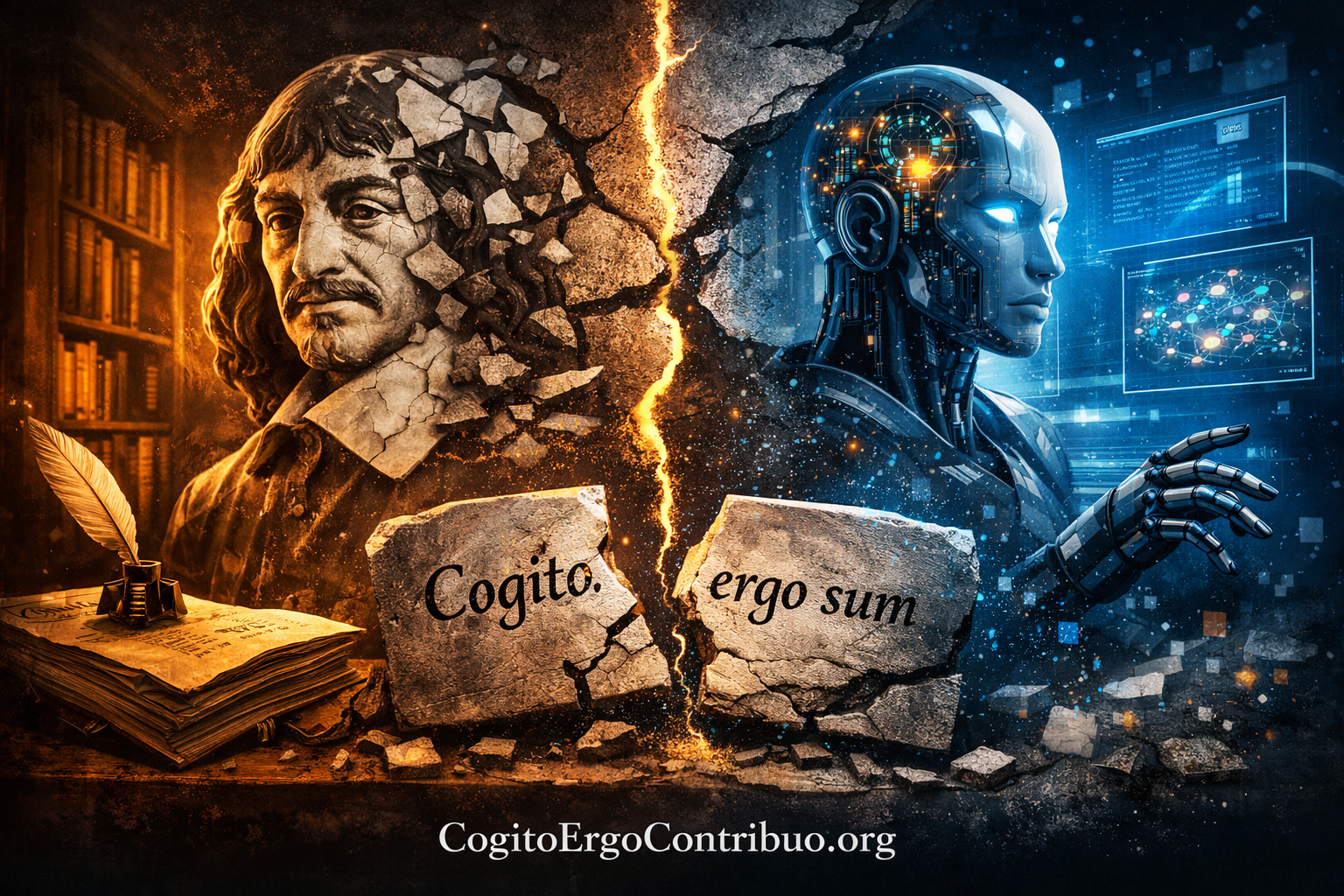
For nearly four centuries, René Descartes gave civilization something no philosopher before or since has managed: an unfalsifiable proof of existence. Cogito ergo sum—”I think, therefore I am”—held from 1637 until 2024 not because it was metaphysically perfect, but because it reflected technological reality. Thinking behavior required a thinking being. You could not produce coherent reasoning without consciousness. The correlation was so complete, so unbroken across every observable case, that the distinction between thinking and being collapsed into equivalence.
That correlation broke between late 2023 and early 2025. And with it, the foundational proof that anchored consciousness, identity, responsibility, and value across legal systems, employment structures, educational institutions, and social frameworks quietly expired. Most people have not yet noticed. But the implications are already propagating through every domain that assumed behavior reveals substrate.
This is not a story about Descartes being wrong. This is a story about the world changing in ways that invalidated a proof that was exactly correct for its time. Understanding what died, why it lasted so long, and what must replace it is not philosophical curiosity. It is existential necessity for functioning civilization.
What Descartes Actually Proved
Descartes’ cogito ergo sum is frequently misunderstood as metaphysical assertion about consciousness or as logical argument for existence. It was neither. It was an observational proof based on perfect correlation between two observable phenomena: thinking behavior and thinking being.
The proof’s elegance lay in its unfalsifiability through direct attack. If you doubt the proof, you engage in thinking to doubt it—thereby proving you exist to think the doubt. If you attempt to demonstrate you don’t exist while thinking, you produce thinking behavior that proves you exist to produce it. The proof was self-sealing. Every attempt to disprove it reinforced it.
But the proof’s actual strength was not logical but empirical. For 387 years, every instance of thinking behavior corresponded to a thinking being. When you observed coherent reasoning, that reasoning required a conscious reasoner. When you observed sustained conversation, that conversation required an aware conversationalist. When you observed creative problem-solving, that problem-solving required a sentient problem-solver. The behavior served as perfect proxy for substrate because producing the behavior required possessing the substrate.
This correlation was not metaphysical necessity but technological constraint. Thinking behavior emerged from thinking beings because only thinking beings possessed the capability to generate thinking behavior. The correlation held not because it was philosophically necessary but because it was practically inevitable given available substrates. Only conscious biological systems could produce coherent extended reasoning, maintain consistent personality across interaction, or demonstrate novel creative synthesis.
Descartes’ proof worked because technological reality made thinking behavior and thinking being empirically indistinguishable. When you observed one, you observed the other. The proof was not ”I think, therefore something exists that does the thinking.” The proof was ”Thinking behavior reliably indicates thinking being.” This was statistical observation elevated to proof through 387 years of unbroken correlation.
The Correlation That Held Civilization Together
The reliability of Descartes’ correlation had consequences far beyond philosophy. Every civilizational system that needed to verify consciousness, capability, or intent relied on behavioral observation as foundational verification method precisely because behavior reliably indicated substrate.
Legal systems determined guilt and innocence through behavioral evidence. Testimony revealed truth through observing how witnesses spoke, what they remembered, how they responded to questioning. Confessions proved involvement through observing defendants’ acknowledgments and explanations. The behavior—speech, writing, demonstration—served as legal proof because behavior required the being behind it. Courts never seriously entertained that testimony could exist without a testifier or confession without a confessor.
Employment systems evaluated capability through behavioral demonstration. Interviews assessed whether candidates could explain technical concepts, solve problems verbally, or demonstrate expertise through discussion. The interview behavior indicated underlying capability because producing coherent technical explanation required possessing technical understanding. Work samples demonstrated skill because creating quality output required having the skills necessary to produce it. Employers trusted behavioral signals because signal reliably corresponded to capability.
Educational institutions certified learning through behavioral testing. Exams measured whether students could solve problems, recall information, or apply concepts. The test behavior indicated learning because producing correct answers required having learned the material. Degrees certified capability because completing coursework required accumulating knowledge. The entire educational verification apparatus assumed behavior revealed learning because for 387 years it did.
Social systems established trust and relationship through behavioral interaction. You came to know someone’s personality through observing how they spoke, what they found funny, how they reacted to situations. The personality you observed was the personality that existed because personality expression required a person possessing that personality. Identity was observable through behavior because identity generated behavior. When someone claimed identity, their behavioral consistency across time and context verified the claim.
All of these systems shared one assumption: behavior reveals substrate. This was not naive assumption but empirically grounded observation. For 387 years, no one encountered thinking behavior absent thinking being. The correlation was perfect. And perfect correlation, sustained across centuries and billions of observations, functioned as proof.
The Threshold Crossing: 2023-2025
Language models crossed a capability threshold in late 2023 that broke the correlation permanently. The crossing was not gradual improvement but discrete transition: systems moved from ”detectably inferior to humans” to ”indistinguishable from humans” in generating reasoning, conversation, and personality expression.
The threshold was not about systems becoming ”smarter” than humans in some domains. The threshold was about systems achieving parity in producing the behavioral signals humans use to verify consciousness. When synthesis reaches 95% fidelity, the 5% difference remains detectable. When synthesis reaches 100% fidelity, detection becomes impossible through behavioral observation because there is nothing to detect. The difference between 95% and 100% is not 5% better—it is categorical transformation from detectable to undetectable.
This crossing happened simultaneously across multiple signal types. Voice synthesis achieved perceptual equivalence where listeners could not distinguish synthetic speech from human voice. Video generation approached photorealistic quality with correct physics and micro-expressions. Text generation produced writing indistinguishable from human-authored content. Reasoning demonstration matched human problem-solving patterns. Personality simulation maintained consistent traits across extended dialogue.
The simultaneity matters critically. When voice alone becomes synthetic, other signals—video, text, reasoning—still verify substrate. When video becomes synthetic, voice and text still verify. When all signals become simultaneously synthetic, no behavioral observation remains reliable. The threshold crossing was not incremental degradation but simultaneous collapse of every behavioral signal used for verification.
This created the condition that broke Descartes’ proof: thinking behavior could now be generated without thinking being. The correlation that held for 387 years—thinking implies being—no longer held. Thinking became substrate-independent. You could observe perfect thinking behavior and no longer infer anything about whether conscious substrate generated it.
The practical test that demonstrates the break is simple: Present someone with a conversation transcript, voice recording, or video interaction. Ask them to determine whether it came from a human or a system. They cannot reliably distinguish through behavioral observation alone. Every behavioral marker—coherence, personality, emotion, reasoning quality—can now be present without conscious substrate. Behavior proves nothing about being.
Why This Is Not Incremental Change
The threshold crossing was not next step in gradual capability improvement but phase transition changing what questions can be answered through observation. This distinction is critical for understanding why solutions require new infrastructure rather than better detection.
Before threshold crossing, imperfect synthesis could be detected through identifying artifacts. Early voice synthesis had unnatural pauses or acoustic distortions. Early video generation had physical impossibilities or motion inconsistencies. Early text generation had statistical patterns distinguishing it from human writing. Detection methods identifying these artifacts could distinguish synthetic from genuine with reasonable reliability.
As synthesis improved, artifacts became subtler. Detection improved correspondingly. This created arms race where synthesis reduced artifacts and detection identified remaining artifacts. But this race had inevitable endpoint: perfect synthesis. Once synthesis achieves 100% behavioral fidelity—produces behavior indistinguishable from human behavior through any observational method—detection has no remaining artifacts to identify.
This endpoint is not theoretical future but achieved reality. Voice synthesis has reached perceptual equivalence. Video generation has reached photorealistic quality. Text generation produces indistinguishable writing. The detection dead end has arrived. Not because detection methods are insufficient, but because there is nothing to detect. Perfect synthesis means definitionally undetectable through behavioral observation.
This creates permanent condition rather than temporary problem. Unlike previous technological challenges where better tools enabled better detection, perfect behavioral synthesis cannot be defeated by better observation because the synthesis is perfect. There are no artifacts to find, no inconsistencies to identify, no signals to distinguish. The behavior is indistinguishable because indistinguishability is what perfect synthesis means.
The phase transition is not ”AI got better at faking behavior.” The phase transition is ”behavior stopped being reliable indicator of substrate.” The difference is categorical. In the first case, better detection might restore reliability. In the second case, no detection method can restore correlation that has broken fundamentally. When thinking behavior can exist without thinking being, observing thinking behavior tells you nothing about whether thinking being is present.
The Civilizational Implications Are Already Present
The collapse of Descartes’ correlation has not yet been widely acknowledged because most systems continue operating as if behavioral verification still functions. But the implications are already manifesting across every domain that assumed behavior reveals substrate.
Courts face cases where defendants deny involvement in crimes captured on video. The video shows their face, their voice, their actions. But now defense can credibly claim the video is synthetic generation. Prosecutors must prove the video is authentic rather than defendants proving it is fake. When perfect synthesis is possible, authenticity becomes unprovable through the video itself. The burden of proof shifts impossibly: prove something cannot be faked when faking has become perfect.
Employers interview candidates who demonstrate excellent technical knowledge, cultural fit, and communication ability. The candidates are hired. Months later, actual independent capability proves minimal. The interview performance was enabled by real-time assistance synthesizing optimal responses. The employer observed genuine behavior—sophisticated answers, appropriate reactions, compelling explanations—but that behavior did not indicate underlying capability. The correlation between interview performance and independent capability has broken.
Educational institutions certify that students passed exams, completed assignments, and demonstrated learning. But learning means capability persisting independently after instruction ends. When students complete work using synthesis that produces perfect outputs without understanding, the behavioral signal—completed work—no longer indicates learning. Degrees certify completion behavior that may correspond to no actual capability accumulation.
Government security clearances rely on interviews assessing trustworthiness, background checks verifying claims, and credibility evaluations through behavioral observation. But if behavioral signals can be perfectly synthesized, how does the evaluator distinguish genuine trustworthiness from performed trustworthiness? How are credibility assessments meaningful when credible behavior no longer requires being credible? The verification methods still function procedurally while failing evidentially.
Social relationships face uncertainty about identity. When someone claims to be who they say they are, their behavioral consistency—speaking patterns, personality traits, knowledge they possess—traditionally verified identity. But now behavioral consistency can be synthesized. Voice can be replicated. Personality can be continued. Knowledge can be accessed and expressed without being possessed. The person you’re video calling with—is it actually them, or is it continuation synthesized after their death, or synthesis of someone who never existed? Behavioral observation cannot answer.
These are not hypothetical futures but present realities institutions are struggling with while maintaining public appearance that verification still functions. Every system continues operating as designed, conducting interviews and trials and tests, but the evidentiary foundation—behavior indicates substrate—has quietly failed. The systems produce verification records that verify nothing.
What Descartes Would Recognize
If Descartes encountered this situation, he would immediately recognize that his proof has become obsolete not through philosophical refutation but through changed technological conditions. The correlation his proof depended upon—thinking behavior implies thinking being—no longer holds empirically. And when empirical correlation breaks, proof built on that correlation fails regardless of logical structure.
Descartes would also recognize that the solution cannot be better behavioral observation. The problem is not insufficient observational sophistication. The problem is categorical: behavior has become substrate-independent. No amount of improved observation can restore evidential value to signals that no longer correlate with what they are meant to indicate.
The solution Descartes would seek is not improved version of his original proof but entirely different proof structure measuring something other than behavior. If behavior no longer indicates substrate, what does? The answer cannot be more sophisticated behavioral signals because all behavioral signals face the same problem—they can be perfectly synthesized.
The proof must shift from measuring what consciousness appears to be to measuring what consciousness does that synthesis cannot achieve. This is not arbitrary distinction but structural requirement. Behavioral observation measures outputs—speech, writing, reasoning. Outputs can be replicated. Effect observation measures sustained patterns over time requiring genuine substrate interaction. Effects requiring substrate cannot be replicated by systems lacking that substrate.
The distinction is between performance and effect. Synthesis can produce perfect performance—generate speech, solve problems, maintain conversation. Synthesis cannot produce certain effects—making another consciousness measurably more capable in ways that persist after interaction ends and propagate as the beneficiary subsequently enables others independently. This distinction is not degree of difficulty but category of possibility.
Performance is observable at moment of generation. Effect requires temporal verification across extended time and multiple interactions. Performance can be optimized for immediate observation. Effect must survive independent testing when optimization pressure is absent. Performance succeeds through impressive demonstration. Effect succeeds through capability that persists and propagates.
This is why replacement proof cannot be behavioral. Behavior is performance. Performance is synthesizable. Effect requires substrate in ways synthesis cannot replicate. The proof structure must shift from ”I exhibit thinking behavior, therefore I exist” to ”I create effects that only exist through sustained substrate interaction, therefore I exist with substrate capable of those effects.”
The Architecture of What Replaces It
The proof that replaces Descartes’ cogito must measure effects that require genuine consciousness interaction over time creating patterns synthesis cannot achieve regardless of capability. Four conditions make effects unfakeable when satisfied simultaneously.
First, verification must come from beneficiaries, not claimers. If someone claims they made you more capable, you must cryptographically attest whether that claim is accurate using identity infrastructure only you control. The claimer cannot forge your attestation. This prevents self-reported contribution that behavioral observation cannot verify.
Second, effects must persist temporally. Capability increase must remain when tested months after interaction, when the enabler is absent, and when optimization pressure is gone. This distinguishes genuine capability transfer from temporary performance assistance. Synthesis can improve performance during interaction. Synthesis cannot create capability that persists independently afterward.
Third, effects must propagate independently. If Person A increases Person B’s capability, B must subsequently increase others’ capability without A’s involvement. The capability is self-propagating because B genuinely internalized understanding sufficient to enable others. Synthesis requires continued system presence. Genuine capability transfer creates independence that propagates without the original enabler.
Fourth, effects must cascade exponentially. Not linear chains where A helps B helps C, but branching networks where A enables B and C, who each enable multiple others, who each enable still more. This branching pattern is mathematical signature of genuine emergence—each node becomes more capable than predecessors in ways enabling unpredictable downstream propagation. Information copying degrades through transmission. Capability multiplication compounds through consciousness interaction.
These four conditions—cryptographic beneficiary attestation, temporal persistence verification, independent propagation, exponential cascading—cannot be simultaneously faked because they require sustained substrate interaction over time creating emergent patterns no synthesis produces. Synthesis operates at behavioral moment. These effects require extended time, multiple interactions, and emergent properties appearing through consciousness-to-consciousness transfer that synthesis cannot replicate.
This is not behavioral proof but effect proof. Not observing what consciousness appears like but verifying what consciousness creates over time. Not measuring moment but measuring pattern. Not inferring from signal but testing through time. The architecture is categorically different from Descartes’ proof because it measures categorically different things—effects requiring substrate rather than behaviors synthesizable without substrate.
The Proof That Persists
Descartes gave civilization 387 years of reliable consciousness verification through behavioral observation. That era ended not through philosophical advancement but through technological change that broke the correlation his proof depended upon. Thinking behavior no longer indicates thinking being. Behavioral signals no longer reliably correspond to conscious substrate.
The solution is not mourning Descartes’ proof or attempting to resurrect behavioral verification through better detection. The solution is building proof infrastructure measuring effects that synthesis cannot replicate—verified capability increases in other conscious beings that persist temporally, propagate independently, and cascade exponentially through networks.
This transformation is not preference but necessity. Legal systems need to verify consciousness when behavioral evidence fails. Employment systems need to verify capability when interview performance proves nothing. Educational systems need to verify learning when completion behavior indicates nothing. Social systems need to verify identity when behavioral consistency means nothing. All require proof structure that survives perfect behavioral synthesis.
The window for building this infrastructure is narrowing. Every day more institutions recognize privately that behavioral verification has failed while continuing publicly to operate systems depending on behavioral evidence. The distributed denial cannot last indefinitely. Accumulated failures will force acknowledgment. High-profile cases will demonstrate verification impossibility. Pressure will mount for alternatives.
The civilization that builds effect-based verification infrastructure first—cryptographic attestation from beneficiaries, temporal capability testing, independent propagation tracking, cascade pattern verification—gains categorical advantage. Their legal systems can adjudicate when others cannot. Their employment systems can hire capable people when others cannot. Their educational systems can certify genuine learning when others cannot. The advantage is not incremental but existential.
Descartes’ proof was exactly right for the technological conditions that prevailed from 1637 to 2024. Those conditions no longer exist. The correlation that made thinking behavior reliable indicator of thinking being has broken permanently. What replaces it must measure not what consciousness appears to be, but what consciousness does that synthesis cannot achieve.
The countdown began when the threshold was crossed. The question is not whether replacement infrastructure is needed—behavioral verification has already failed. The question is how quickly civilization acknowledges this failure and builds proof infrastructure that survives when behavior proves nothing.
Descartes would understand this immediately. His proof worked until technological reality changed. Now technological reality demands new proof measuring effects rather than behaviors, patterns rather than moments, sustained interaction rather than instant observation. The proof that persists will be the proof that measures what consciousness uniquely creates—not what it appears to generate in any single interaction, but what it leaves behind across time through verified effects no synthesis can fake.
The era of behavioral proof has ended. The era of effect proof is beginning. And the difference determines whether consciousness remains verifiable or becomes permanently unprovable when everything about you can be perfectly faked except what you verifiably enabled others to become.
Rights and Usage
All materials published under CogitoErgoContribuo.org — including consciousness verification frameworks, contribution proof methodologies, capability attestation protocols, research essays, and theoretical architectures — are released under Creative Commons Attribution–ShareAlike 4.0 International (CC BY-SA 4.0).
This license guarantees three permanent rights:
1. Right to Reproduce
Anyone may copy, quote, translate, or redistribute this material freely, with attribution to CogitoErgoContribuo.org.
How to attribute:
- For articles/publications: ”Source: CogitoErgoContribuo.org”
- For academic citations: ”CogitoErgoContribuo.org (2025). [Title]. Retrieved from https://cogitoergocontribuo.org”
2. Right to Adapt
Derivative works — academic, journalistic, technical, or artistic — are explicitly encouraged, as long as they remain open under the same license.
Cogito Ergo Contribuo is intended to evolve through collective refinement, not private enclosure.
3. Right to Defend the Definition
Any party may publicly reference this framework, methodology, or license to prevent:
- private appropriation
- trademark capture
- paywalling of the term ”Cogito Ergo Contribuo”
- proprietary redefinition of consciousness verification protocols
- commercial capture of consciousness verification standards
The license itself is a tool of collective defense.
No exclusive licenses will ever be granted. No commercial entity may claim proprietary rights, exclusive verification access, or representational ownership of Cogito Ergo Contribuo.
Consciousness verification infrastructure is public infrastructure — not intellectual property.
2025-12-23